insulated dome house for cold climates
Insulated Dome House for Cold Climates: How 18cm Solid EPS Walls Perform Below Freezing
Cold-climate procurement guide for EPS dome houses: R-value baselines, thermal-bridge questions, Canada and US Northeast scenarios, and heating-cost math.
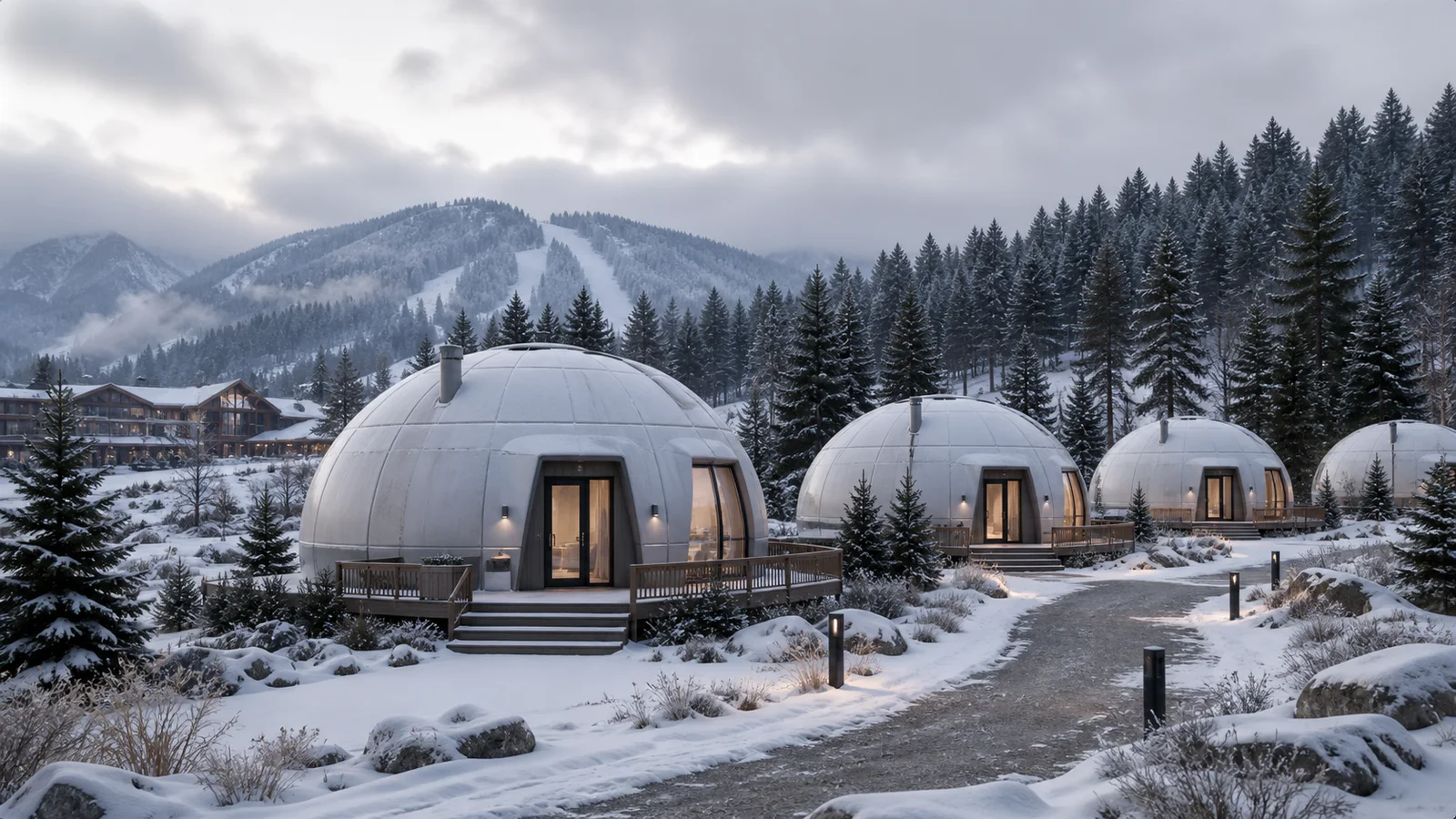
PVC fabric domes need swappable thermal liners every 5-7 years. Concrete monolithic domes don’t ship in a container. Geodesic kits concentrate thermal-bridge questions at strut junctions. Vaultwerk’s 18 cm modified-graphene EPS module gives cold-climate buyers a strong wall-body starting point, while code approval, snow-load review, air sealing, and heating economics still remain site-specific. This page documents the spec, the connection-node questions, the operating-cost framework, and the limits — not a year-round performance guarantee.
What Counts as “Cold-Climate Capable”?
An insulated dome house for cold climates is a prefab dome whose envelope, structural load capacity, and operating temperature range are documented against four engineering benchmarks. A “4-season prefab dome house” claim is only as solid as the test data behind those four numbers — fabric domes, geodesic kits, and modular EPS shells all reach this category differently, and procurement decisions hinge on which dimension is verified at the wall, at the joint, and at the site. The Vaultwerk Dome Series uses a single 18 cm modified-graphene EPS wall as its envelope baseline, with full product context covered in the prefab dome house guide.
| Dimension | Engineering benchmark | Why it matters |
|---|---|---|
| Envelope R-value | Industry-standard solid EPS sits in the R-25 to R-30 region at 18 cm thickness, calculated from a per-inch baseline of R-3.6 to R-4.2.1 | Drives heating energy demand and indoor comfort under continuous winter operation. |
| Thermal bridging at the joint | Continuous-wall designs eliminate frame penetrations; modular wall systems require verified node detailing. | Frame and seam penetrations are the dominant winter condensation and infiltration source. |
| Snow load rating | Reference snow load determined per IBC 2021 §1608 (US, design snow loads per ASCE 7-16 Chapter 7) and NBC 2020 Subsection 4.1.6 (Canada, Loads Due to Snow and Rain).23 Northern North-American zones often design to 1.5–2.5 kPa or higher. | Site-specific structural review required; this is not a one-size-fits-all spec. |
| Operating temperature spread | Manufacturer reference: a stated exterior operating range of −40 °C to 40 °C, plus a separate indoor 18–23 °C comfort reference under project-specific envelope, air-sealing, and HVAC assumptions.45 Export reference markets include Canada, the United States, and Sweden; operating-envelope validation remains project-specific. A separate installation temperature constraint applies — see below. | Defines whether the unit is operated year-round or seasonally; HVAC sizing follows from this spread. |
A unit that hits only one of these four dimensions is not cold-climate capable — it’s a wall spec without a system. The rest of this page documents the Vaultwerk Dome Series position against each benchmark, the connection-node engineering that ties them together, and the operating-cost framework that turns the numbers into a budget input.
What deep-snow service actually looks like on the shell, from a production-side reference project in a heavy-snow region:
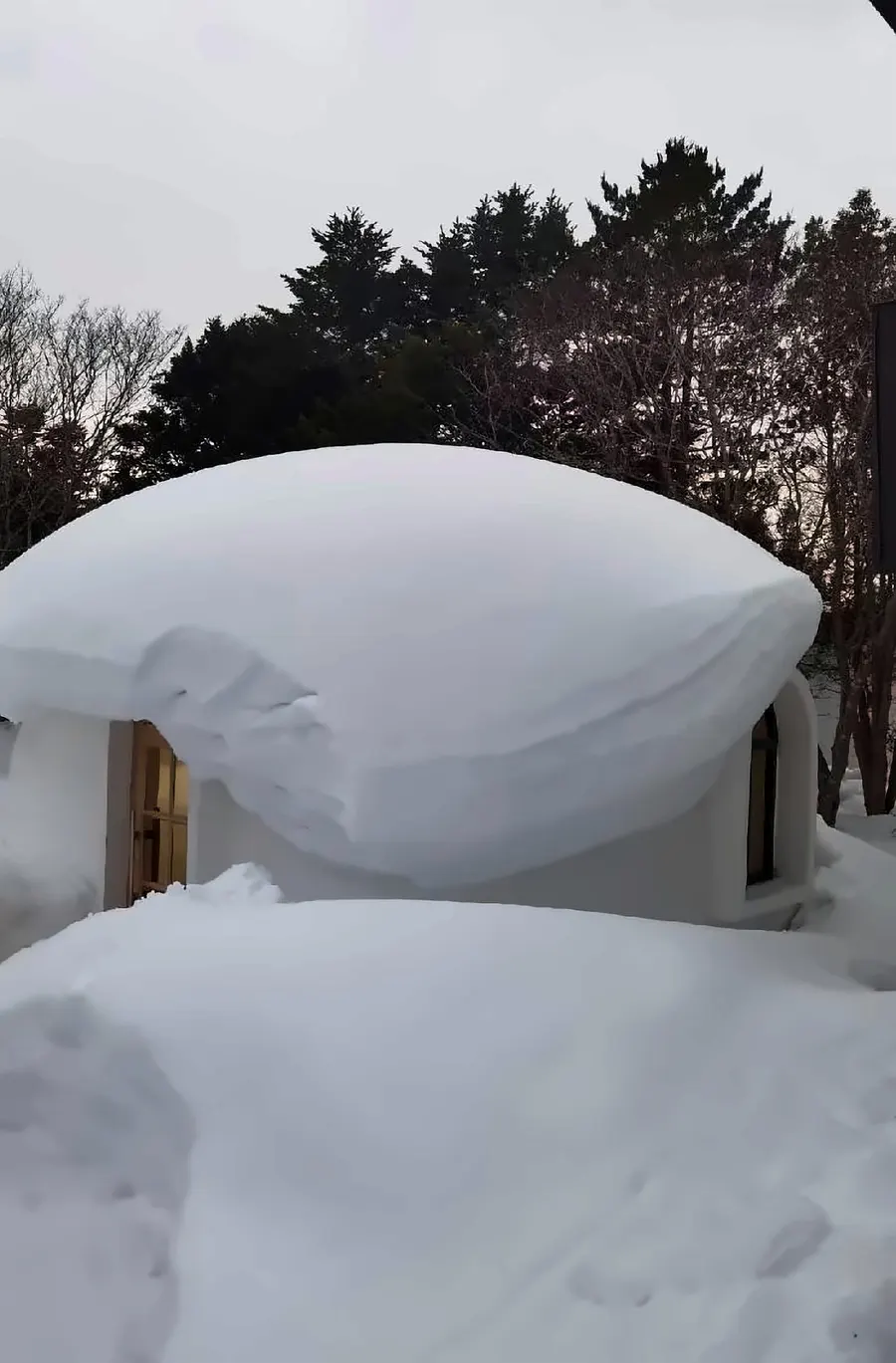
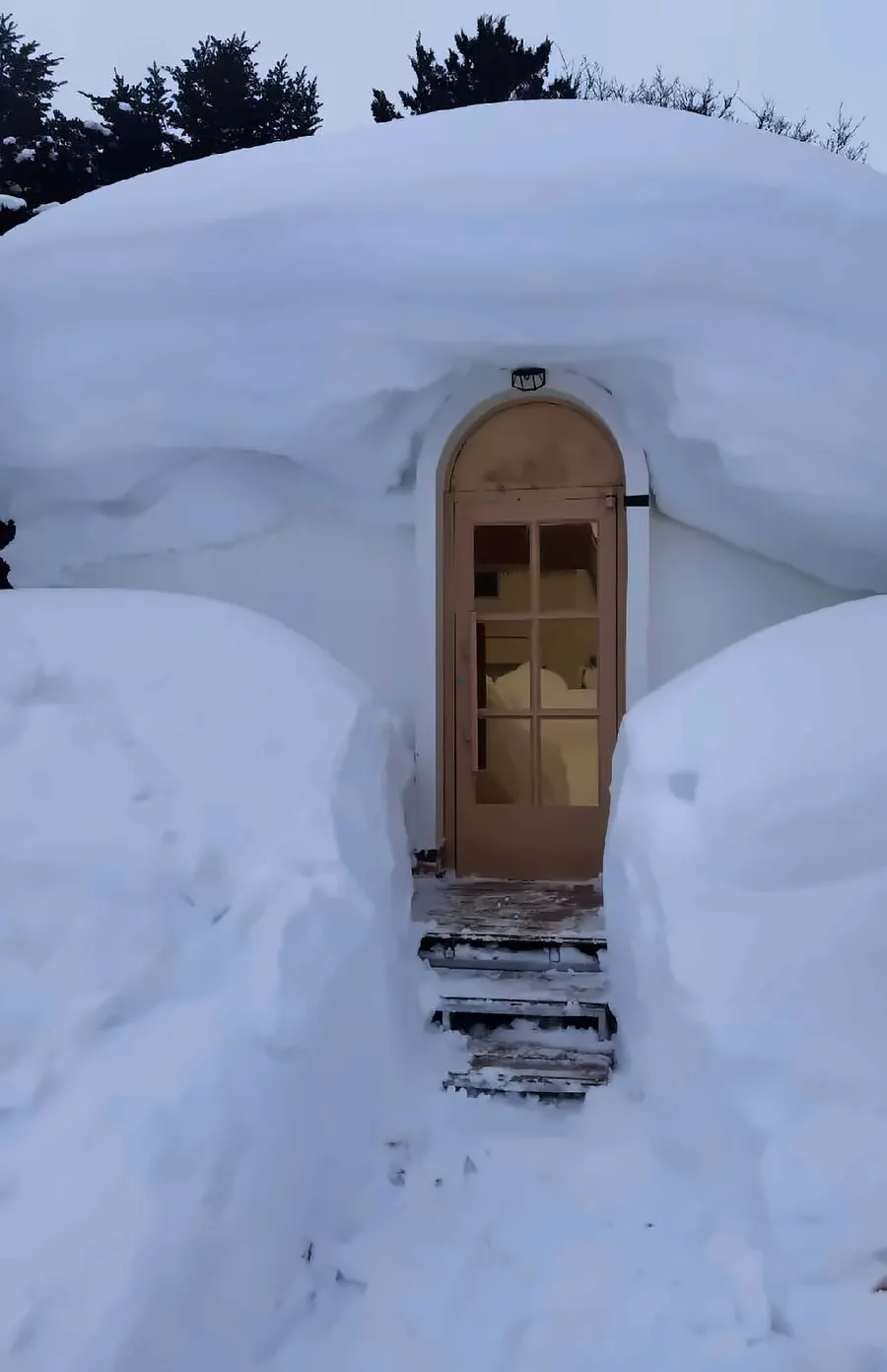
Operating range vs. installation window
Two temperatures matter in cold-climate procurement, and they are not the same number.
Operating range. The manufacturer’s stated operating range for the finished envelope is −40 °C to 40 °C.5 Expanded polystyrene’s continuous service temperature is generally cited around 75 °C, so a 40 °C summer ceiling sits well within the material limit, and sub-zero exterior conditions are a comfort-and-HVAC-sizing question rather than an EPS material failure point. This is manufacturer guidance, not a third-party tested performance certificate — treat indoor comfort as a function of the R-value, air sealing, set-point, and HVAC sizing discussed below, and confirm the operating envelope per project.
Installation window. The exterior system that finishes the EPS modules — mortar render, mesh, waterproofing, and coating — is wet work that needs above-freezing (above 0 °C) conditions to cure properly. The practical scheduling consequence for a heating-heavy site: modules can often be delivered ahead of the finishing window and stored under supplier-specified packaging, weather-protection, and handling conditions, while the wet finishing trades are scheduled into an above-freezing window rather than a mid-winter finish. Build that into the project timeline, and confirm the exact storage, temperature, and cure-time detail with the supplier for your site.
EPS Wall Thermal Performance
The EPS dome house cold climate spec — what procurement teams also search as the insulated dome house cold climate category — starts at the wall. The Vaultwerk Dome Series uses an 18 cm modified-graphene EPS module — a closed-cell, graphite-enhanced expanded polystyrene core with a factory-applied exterior mortar, mesh, and coating system. That single 18 cm continuous layer is what gives the module its cold-climate starting position: no framing penetrations through the insulation, no panel-to-panel seams that depend on field gasket replacement, and no liner that degrades on a 5–7 year cycle. See the insulated EPS layouts on the Dome Series product page.
A buyer comparing a winter glamping dome tent should separate the fabric shell from the thermal liner: many tent-style packages add insulation as a replaceable inner layer, so the quote must name the liner R-value, cleaning cycle, replacement cycle, and condensation-control detail. A buyer comparing a geodesic dome house should ask where the published R-value is measured — panel body, SIP panel, or installed frame assembly — because strut junctions and panel seams can become the cold-climate weak points.
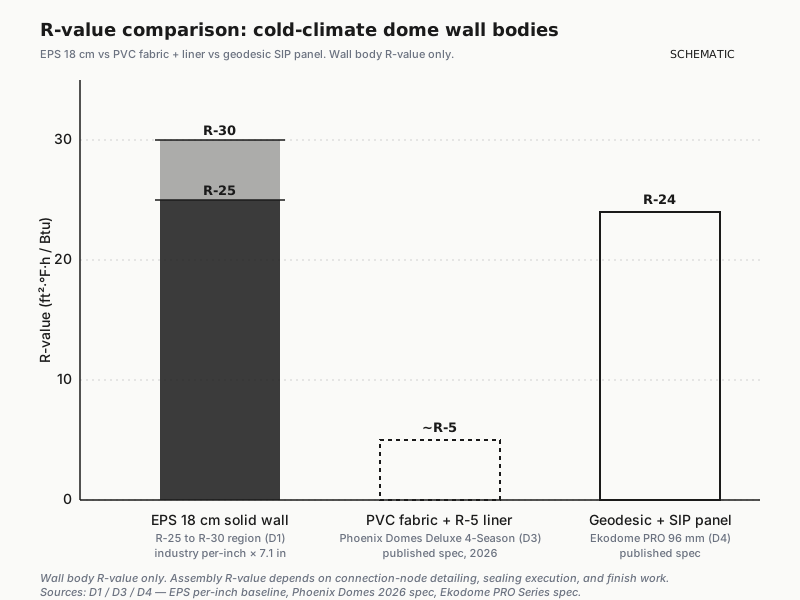
The numbers, on a like-for-like basis where each manufacturer publishes a comparable value, look like this:
| Dimension | EPS 18 cm solid wall | PVC fabric + R-5 thermal liner | Geodesic kit + foam / SIP panel |
|---|---|---|---|
| Nominal R-value | R-25 to R-30 region — industry solid EPS R-3.6 to R-4.2 per inch × 7.1 in = R-25.6 to R-29.8.1 Assembly R-value not published. | ~R-5 thermal liner (Phoenix Domes Deluxe 4-Season Kit, 2026 published spec).6 | R-24 (Ekodome PRO Series 96 mm SIP geodesic publishes R-24; older foam-panel kits sit lower).7 |
| Thermal bridges | None at module body; node detailing engineered per project. | Many — frame straps, zippers, door zippers. | Many — strut junctions, panel seams. |
| Condensation risk under continuous winter operation | Low — vapor-permeable EPS body + interior breathability; node detailing must be verified. | High — interior-wall condensation on liner reported in cold-climate operation. | Medium — strut cold-bridging causes localized condensation. |
| Envelope maintenance cycle | EPS module body is not a fabric-cover replacement item; exterior coating, sealants, warranty term, and maintenance interval are pending manufacturer confirmation. | 5–7 yr (UV and moisture degradation of fabric + liner). | Panel-dependent, gasket replacement cycle. |
| Field-replaceable component | No — designed monolithic. | Yes — liner swap every 5–7 yr (lifecycle cost stacking covered in the EPS vs PVC dome TCO breakdown). | Yes — panel-by-panel. |
The R-25-to-R-30 region is the EPS core position calculated from industry per-inch baselines — graphite-enhanced EPS variants such as the BASF Neopor family target the upper end of that range,8 but verified third-party assembly R-value test data for the Vaultwerk Dome Series is pending the manufacturer’s Q8 reply in the questionnaire on file. We do not publish an assembly R-value — the installed wall R-value depends on connection-node detailing, sealing-tape execution, and on-site finish work. Treat the EPS core R-value as a strong starting condition, not an installed assembly guarantee.
For the prefab dome winter performance R-value question that procurement teams ask first, the practical answer: the EPS wall body calculates into the R-25-to-R-30 region in a continuous run; the installed assembly variable is the joint, and that’s the next section.
Continuous Envelope + Connection-Node Engineering
The connection node — where one EPS module meets the next — is where cold-climate procurement decisions concentrate. The wall body has its starting R-value (S2). The remaining variable is the joint: thermal envelope continuity, air sealing, condensation risk, HVAC zoning, maintenance access, and what to ask the supplier in a quote.
Continuous envelope at the module body
The 18 cm modified-graphene EPS module is shipped as a closed-cell solid panel — no through-framing, no panel-to-panel infill. Modules join through an interlocking joinery profile with a factory-applied sealing-tape detail at the wall body; in a continuous run the joint sits inside the closed-cell envelope rather than puncturing it. That keeps the core R-value (S2) close to its starting position along the run of a single dome’s wall. The variable starts at the connection node — where module-to-module joins occur in a multi-module shell, and where module-to-module connections join two separate domes into one volume. Multi-SKU connection (e.g., 28 m² + 40 m² joined into a single building) is the Vaultwerk Dome Series differentiator versus PVC fabric and geodesic kit competitors; the multi-unit layout side of that story is covered in the resort spoke on connected dome layouts.
Connection-node engineering — five cold-climate procurement dimensions
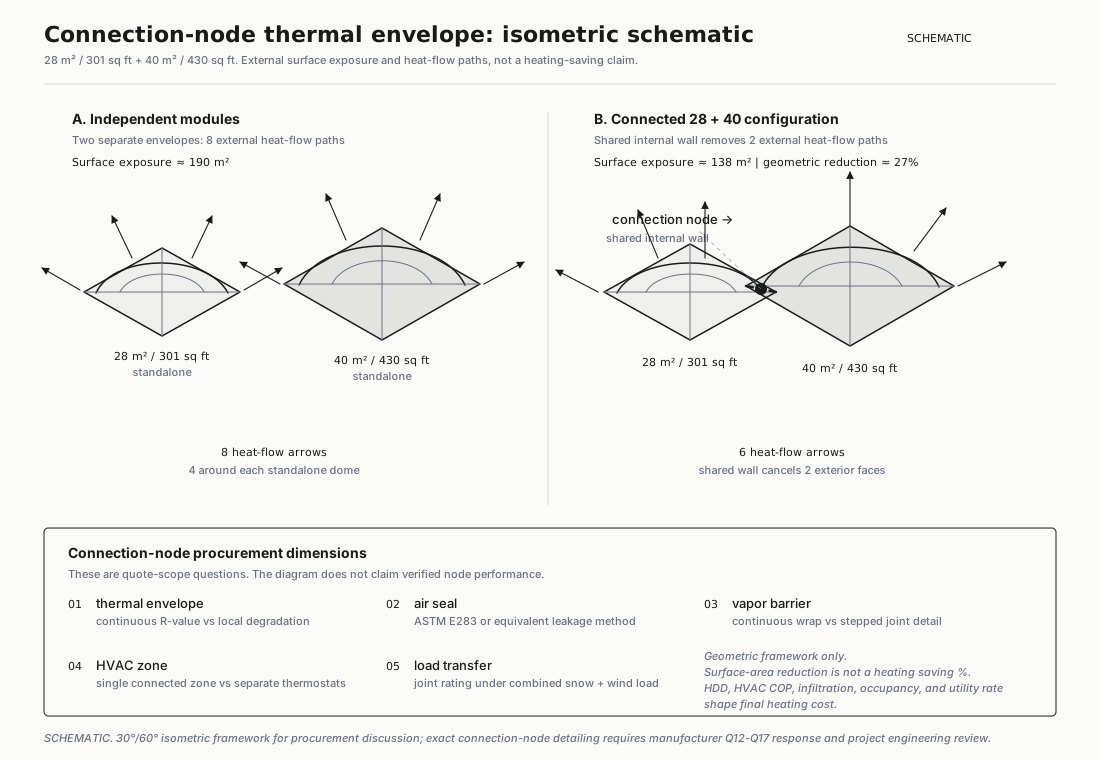
| Dimension | What it means for cold climate | What to ask the supplier in a quote |
|---|---|---|
| Thermal envelope continuity at joint | The R-value at module-to-module joints determines whether the wall reads as continuous or as a series of weak spots. EPS module bodies sit in the R-25-30 region (S2); the joint must not be a thermal break. | ”What’s the verified R-value at module joints — continuous, or local degradation? Is there third-party assembly test data?” |
| Air sealing at node | Air leakage at module joints converts directly into heating-energy loss and occupant draft. Standard test method: ASTM E283 air leakage or equivalent. This is where EPS dome house thermal bridging risk concentrates if joint sealing is inconsistent. | ”Air-leakage rate per node — what’s the test method and the published rate?” |
| Condensation risk at vapor barrier | Cold-climate ΔT (interior 20 °C to exterior –20 °C+) drives vapor migration toward the cold side; a discontinuous vapor barrier at the joint creates a condensation high-risk zone. | ”Vapor barrier detail at joints — continuous wrap, or stepped joint? Show the field detail.” |
| HVAC zoning across connected modules | A twin or cluster configuration (e.g., the Vaultwerk Dome Series 28 + 40 connected layout) can run as one HVAC zone or as independent zones with separate thermostats per module — that decision shapes winter operating logic for an insulated dome cabin built as a multi-volume unit. | ”Can each connected module run independent thermostat / HVAC zoning? What’s the duct routing across the connection?” |
| Snow / wind load transfer at joint | The structural rating at the module-to-module joint under combined snow and wind load must meet local site-specific structural review. Continuous wall and connection node have different structural ratings. | ”Joint structural rating under combined snow + wind load — what test or analytical model, and what’s the site-specific structural review burden on the buyer?” |
Connection geometry and heating implications — framework, not saving %
The 28 + 40 connected layout (and 3-module clusters) reduces total external surface area because joined modules share an internal wall instead of presenting two external walls to the cold side.
- 28 m² module standalone: external surface area ≈ 85 m² (dome wall + base, geometric approximation)
- 28 m² + 40 m² connected (sharing one common wall): external surface area ≈ 138 m² (vs 85 + ~105 = 190 m² if placed independently) — a geometric reduction of approximately 27%
- 3-module cluster (sharing two internal walls): geometric reduction of approximately 30–35% vs three independent domes
These are geometric estimates only — they describe surface area, not heating cost. Actual heating-energy impact depends on HVAC system efficiency (a heat-pump COP of 2.5–3.0 can cut the electric-resistance number by 2–3×), infiltration rate at joints (returns to the air-sealing dimension above), interior heat gain, occupancy patterns, and the local HDD. Geometric reduction is not a heating saving %. The framework example in the next section feeds these geometry numbers through HDD and U-value to show what the formula yields under explicit assumptions — but the output is a budgeting variable, not a saving guarantee.
Connection capability between standard dome modules is confirmed by the manufacturer — the standard layouts connect on the module modulus and joined modules share an internal wall. The detailed node test data — node air-leakage rate, joint vapor barrier continuity detail, joint snow-load structural rating, and HVAC duct routing — remains project-specific and is not publicly published; the framework above describes the engineering questions to put into a project-scoped quote.
Cold-Climate Climate Scenarios: Where This Matters
This section reads as climate scenarios — how a procurement team frames an insulated dome house for cold climates against the local code, climate zone, and certification expectation in a specific region. It is not a country-by-country market guide, and the page does not stand as a doorway page for any single jurisdiction.
Use the regional notes as a filter, not as a broad “winter glamping dome” promise. A PVC tent with a liner, a geodesic frame kit, and an EPS modular dome can all be marketed as four-season; the procurement difference is whether the supplier can document wall-body R-value, joint thermal bridging, air sealing, condensation control, snow-load review, and local approval path for the actual site.
Canada cold-climate scenario
For an insulated dome house Canada procurement scenario, the cold-climate frame is built around three reference points: National Building Code 2020 Section 9.36 (the energy-efficiency provisions for housing and small buildings),9 the NBC structural load chapters — Subsection 4.1.6 (Loads Due to Snow and Rain) and Subsection 4.1.7 (Wind Loads)3 — and CSA A277-16 (R2021), the factory-built modular consistency certification path.10
Section 9.36’s envelope requirements are keyed to climate zone, not to a single national R-value number. NBC 2020 Appendix C Table C-2 defines six building climate zones by heating-degree days (HDD@18 °C): Zone 4 (<3,000 HDD) through Zone 8 (>7,000 HDD), with the heating-heavy population centres falling in Zone 5 (Toronto), Zone 6 (Halifax, Lethbridge ~4,000–4,500 HDD), Zone 7A (Edmonton ~5,120 HDD, Winnipeg ~5,670 HDD), and Zone 7B (Fort McMurray ~6,250 HDD) — with Zone 8 reaching ~8,950 HDD at Churchill, Manitoba.11
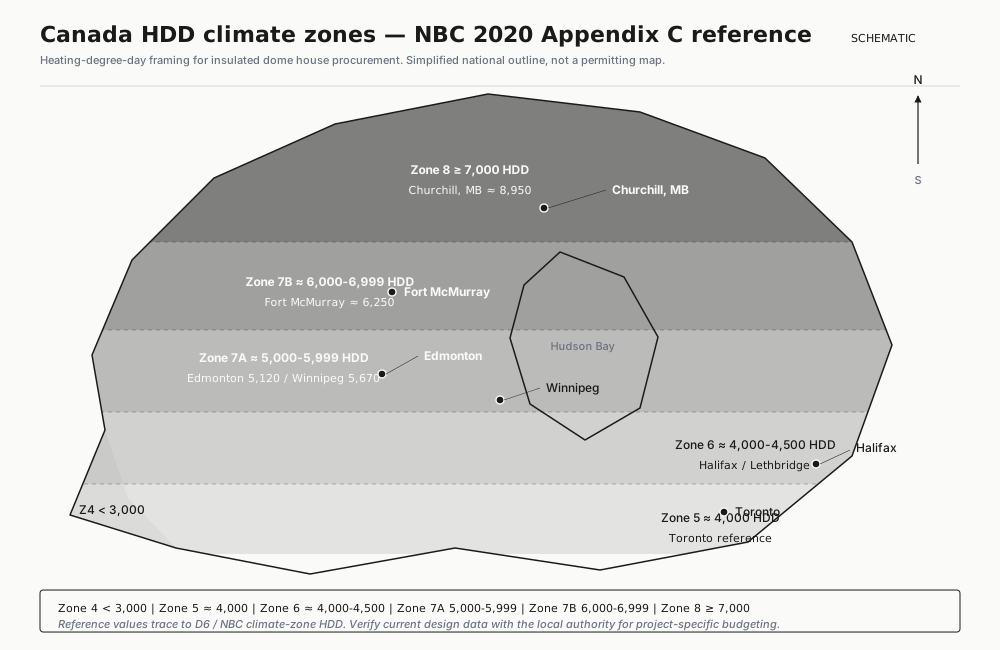
The manufacturer export list includes Canada; this is a market reference, not a Canadian permit approval or winter-performance guarantee. The operating envelope spec is a documented starting condition, not a permit guarantee. Permit process varies by province and municipality — Ontario’s Building Code, BC’s Energy Step Code, and Alberta’s regional building services each apply their own envelope tables. Check with your local building official before committing to a delivery date.
Certification path caveats: CSA A277-16 (R2021) is a candidate Canadian factory-built modular consistency path. Supplier availability, fee, and timeline are pending the Q8 reply. NBC Part 4 site-specific snow-load (4.1.6) and wind-load (4.1.7) review remains the buyer’s responsibility for permit application.
US Northeast cold-climate scenario
For US Northeast — Vermont, Maine, upstate New York, New Hampshire, Western Massachusetts — the cold-climate frame is built on IECC 2021 climate zones 5 and 6 envelope requirements12 and IBC 2021 Section 1608 (Snow Loads), with design snow loads determined per ASCE 7-16 Chapter 7.2 IECC 2021 Table R402.1.3 prescribes a wood-frame wall assembly of R-20+5ci or R-13+10ci in zones 5 and 6 (cavity-only is closed in those zones; continuous insulation is mandatory) and ceiling/attic at R-49. Verify against the current IECC table for the project’s exact township.
For a year-round glamping dome siting in the US Northeast, the practical certification chain layers on top of the envelope number: ASTM E84-26a (Standard Test Method for Surface Burning Characteristics of Building Materials)13 is requested for foam plastic insulation under IBC 2021 §2603 (foam plastic — primary path for EPS structural modules) and for interior finish materials under IBC §803. Assembly-level exterior wall tests such as NFPA 285 may apply for taller mid-rise applications but generally not for single-story dome cabins. State adoption varies: Massachusetts (IECC 2021 + state amendments), Connecticut (IECC 2021), and New York (IECC 2021 + NY amendments) reference the 2021 IECC; New Hampshire references the 2018 ICC code family with NH-specific energy amendments, not IECC 2021 — always verify against the locally adopted edition. The dome shell envelope spec is a starting condition; the AHJ’s exact requirement is determined site-by-site.
Nordic future / comparison note
Sweden appears in the manufacturer’s export list; this is a precedent for inquiry routing, not proof of Nordic code compliance or high-HDD performance. For deeper Nordic market work — national building-code envelope tables for Sweden, Norway, Finland, and Denmark — this page does not stand as a comparison reference; if Nordic inquiries arrive, the Vaultwerk product team will publish a dedicated scenario page with EN-specific evidence. Today, Nordic export is a reference precedent, not a certification chain.
Year-Round Operating Economics
Heating-cost framework — variables, not guarantees
A cold-climate buyer wants a heating-cost number. This page does not publish a fixed saving — operating cost depends on HVAC system, occupancy, infiltration, and local utility rate, all of which sit outside the dome shell spec. What the page does publish is the framework, so a procurement team can plug in its own assumptions and get a budgeting anchor. For 10-year capital + replacement + lifecycle stacking on top of this single-year operating framework, see the EPS vs PVC dome TCO comparison.
The first-principle heating-cost formula:
Annual heating energy (kWh) ≈ envelope area (m²) × U-value (W/m²K) × HDD × 24 × 0.001
Annual heating cost ($)     ≈ Annual heating energy × local utility rate ($/kWh)
Framework example (engineering example, not a quote):
- 28 m² Vaultwerk Dome Series module envelope area ≈ 85 m² (geometric approximation, see S3)
- 18 cm solid EPS wall U-value ≈ 0.20 W/m²K (calculated from industry R-3.6 to R-4.2 per inch baseline;1 assembly U-value not published)
- Ottawa-area HDD@18 °C ≈ 4,500 (NBC 2020 Appendix C Table C-2, Zone 6 reference range)11
- Ontario all-in delivered electric rate ≈ 16¢ CAD/kWh (conservative anchor inside the Ontario Energy Board RPP 9.8¢ off-peak / 20.3¢ on-peak November 2025 – October 2026 band, including delivery + regulatory charges; adjust for your local utility and season)14
- Electric-resistance baseline (no heat-pump COP applied)
Under those assumptions, the framework yields:
- EPS framework example: ~1,836 kWh/yr → ~$294 CAD/yr per dome (envelope only, electric resistance, continuous 20 °C, no occupant gain)
- PVC fabric + R-5 liner framework example (U ≈ 0.95 W/m²K, same other assumptions): ~8,721 kWh/yr → ~$1,395 CAD/yr per dome
The framework shows the envelope U-value is roughly 5× lower for the EPS wall than for the PVC fabric + R-5 liner in this example. The framework does not show a fixed saving percentage. A heat-pump COP of 2.5–3.0 cuts the electric-resistance number by 2–3× across both rows; occupancy patterns, infiltration at connection nodes, and the actual utility tariff structure shift the absolute numbers in either direction. Treat these numbers as variable framework anchors, not validated operating budgets — rerun the formula with the project’s own HDD, HVAC system, and rate.
4-season operating variables — not revenue promises
Extending from a 3-season to a 4-season operation changes the annual booking-night supply on a heating-heavy site, but how much depends on local glamping demand, pricing power, competitive supply, amenity stack, and brand positioning — none of which are dome-shell variables. The envelope spec in S2 is a starting condition that makes year-round operation physically possible; whether year-round operation is also financially worthwhile is the operator’s revenue-side decision, and is the same analysis a multi-unit resort developer runs at site-planning time.
Third-party industry data points to a US glamping ADR of roughly $251/night across the standard accommodation mix and ~$257/night specifically for dome accommodations (Sage Outdoor Advisory Q2 2025).15 Seasonal occupancy benchmarks from the same source set sit in the 70–90% peak / 45–65% shoulder / 15–35% off-season range; approximately 63% of US glamping sites are reported to operate year-round.15 This page does not publish a 4-season uplift percentage — validate against your local Airbnb / vacation-rental occupancy data before committing capital to year-round operation.
Procurement decision language — three anchor phrases
For a buyer building a project brief or RFP from a Vaultwerk Dome Series cold-climate inquiry, three anchor phrases keep the scope clean:
- “Configurable envelope target”: 18 cm baseline; higher-performance envelope options must be confirmed per project. Assembly R-value depends on connection-node detailing and on-site execution — the manufacturer publishes the EPS core position, not the installed wall assembly value.
- “Per-unit heating-cost framework, not a quote”: an Ottawa-area framework example yields roughly $250-400 CAD/yr per dome under electric-resistance + continuous-20 °C + no-occupant-gain assumptions; rerun with the project’s HDD, HVAC system, and local rate before budgeting.
- “Cold-climate certification chain”: the current public evidence base is SGS RoHS / material-safety evidence plus China GB 8624 B1 fire classification, while EN 13501-1, CSA A277-16 (R2021) for Canadian factory-built modular consistency,10 and ASTM E84-26a for US surface-burning characteristics13 remain candidate destination-market evidence paths. Availability, fee, sample configuration, and timeline are pending the Q8 reply.
Next Steps
If you’re sourcing an insulated dome house for cold climates — prefab EPS dome cabins for a heating-heavy site — the next move is a project-scoped quote conversation, not a generic spec sheet.
Primary: Request a quote scoped to your climate zone. Share your site’s HDD region, target unit count, target use case (4-season camp / permanent BnB / off-grid cabin), and any envelope target (higher-performance or standard).
See also:
- 10-year cost comparison under heating-heavy assumptions → — capital, replacement, and lifecycle stacking on top of the single-year framework example above.
- Full prefab dome house specifications and certifications → — structural, thermal, fire, and seismic spec across the Vaultwerk Dome Series.
- Multi-unit resort layouts for cold-climate operations → — site planning, SKU mix, quote scope tiers, and procurement language for cluster and twin layouts.
- How EPS dome quotes are scoped → — scope tiers, the cost factors that move a quote, and what is normally excluded, so a climate-zone quote request lands with the right inputs.
- Evidence & spec brief → — the current factory document status (GB 8624 B1 fire report, SGS RoHS, floor plans, container-loading references) that supports a local engineer’s cold-climate review.
References
Footnotes
-
Northwest Foam, “EPS Facts” — Type I (1.00 pcf) R-3.85/inch and Type II (1.50 pcf) R-4.17/inch at 75°F mean temp, tested per ASTM C177/C518; data sourced from Nova Chemical Co., BASF Corp., and Huntsman Chemical Company. https://northwestfoam.com/documents/eps-facts/ (accessed 2026-05-31). ↩ ↩2 ↩3
-
ICC Digital Codes, “2021 International Building Code — Section 1608 Snow Loads” (design snow loads per ASCE 7-16 Chapter 7; ground snow load Pg per Figure 1608.2). https://codes.iccsafe.org/s/IBC2021P1/chapter-16-structural-design/IBC2021P1-Ch16-Sec1608 (accessed 2026-05-31). Cross-reference: ASCE/SEI 7-16 Chapter 7 — https://www.asce.org/publications-and-news/asce-7. ↩ ↩2
-
NRC Canada, “Structural Commentaries — User’s Guide, National Building Code of Canada 2020, Part 4” (NBC 2020 Subsection 4.1.6 Loads Due to Snow and Rain; Subsection 4.1.7 Wind Loads). https://nrc.canada.ca/en/certifications-evaluations-standards/codes-canada/codes-canada-publications/structural-commentaries-users-guide-national-building-code-canada-2020-part-4-division-b (accessed 2026-05-31). ↩ ↩2
-
Vaultwerk Dome Series product source pack and manufacturer export reference list (Sweden, Canada, Greece, Turkey, Bulgaria, Japan, Italy, Cambodia, Thailand, Angola, Cyprus, USA, Australia, Denmark) — bilingual model manual and production-side materials reviewed in May 2026. ↩
-
Vaultwerk production-side guidance (June 2026): stated exterior operating range −40 °C to 40 °C; the exterior render, waterproofing, and coating require above-freezing (>0 °C) curing conditions, so winter delivery and storage are possible under supplier-specified packaging and weather protection, with the wet finishing trades scheduled into an above-0 °C window. Manufacturer/sales guidance, not a third-party performance test; confirm per project at quote stage. ↩ ↩2
-
Phoenix Domes, “Deluxe 4-Season Dome Kits” — R5 insulation rating, reflective bubble-wrap insulation and machine-washable Oxford fabric liner, double-layer insulation liners. https://phoenixdomes.com/deluxe-4-season-dome-kits (accessed 2026-05-31). ↩
-
Ekodome PRO Series glamping dome product pages — 96 mm SIP panels rated R-24, thermally broken aerospace-grade aluminum framework, 28 mm argon-filled double-pane glass; older foam-panel geodesic kits sit lower. https://ekodome.com/glamping-domes/ (accessed 2026-05-31; value confirmed via Google SERP snippet due to direct-fetch 403). ↩
-
BASF Neopor product page — graphite-enhanced EPS (GPS) Type 1 0.90 pcf R-4.7/inch vs standard white EPS Type 1 0.90 pcf R-3.6/inch; R-value increases as outdoor temperature drops. https://neopor-insulation.com/ (accessed 2026-05-31). ↩
-
NRC Canada, “Illustrated User’s Guide — National Building Code of Canada 2020, Part 9, Division B” (Section 9.36 Energy Efficiency; prescriptive/trade-off/performance compliance pathways keyed to climate zone). https://nrc.canada.ca/en/certifications-evaluations-standards/codes-canada/codes-canada-publications/illustrated-users-guide-national-building-code-canada-2020-part-9-division-b-housing-small-buildings (accessed 2026-05-31). ↩
-
CSA Group store, “CSA A277-16 (R2021) — Procedure for certification of prefabricated buildings, modules, and panels.” https://www.csagroup.org/store/product/A277-16/ (accessed 2026-05-31). ↩ ↩2
-
NAIMA Canada, “Insulation Requirements” — HDD@18 °C by NBC 2020 climate zone (Zone 4 <3,000 HDD through Zone 8 >7,000 HDD), primary authority NBC 2020 Appendix C Table C-2. https://www.naimacanada.ca/insulation-requirements/ (accessed 2026-05-31). ↩ ↩2
-
DOE Building America Solution Center, “2009-2021 IECC and IRC Minimum Insulation Requirements for New Homes” — IECC 2021 Table R402.1.3 for residential wood-frame construction, climate zones 5 and 6 wall R-20+5ci or R-13+10ci, ceiling/attic R-49. https://basc.pnnl.gov/information/2009-2021-iecc-and-irc-minimum-insulation-requirements-new-homes (accessed 2026-05-31). ↩
-
ASTM International store, “ASTM E84-26a — Standard Test Method for Surface Burning Characteristics of Building Materials” (active revision as of April 15, 2026). https://store.astm.org/e0084-26a.html (accessed 2026-05-31). IBC 2021 path: §2603 (foam plastic insulation — primary path for EPS structural modules; FSI ≤75, SDI ≤450 per §2603.3, FSI ≤25 for exposed exterior applications per §2603.5) and §803 (interior finishes). ↩ ↩2
-
Ontario Energy Board, “Electricity Rates” (Regulated Price Plan effective November 1, 2025 through October 31, 2026: TOU off-peak 9.8¢/kWh, on-peak 20.3¢/kWh; all-in delivered cost approximately 15–18¢ CAD/kWh including delivery + regulatory charges). https://www.oeb.ca/consumer-information-and-protection/electricity-rates (accessed 2026-05-31). ↩
-
Sage Outdoor Advisory, “Glamping Market Trends 2025” Q2 2025 report — dome ADR ~$257/night, treehouse $217, cabin $160 (https://sageoutdooradvisory.com/blog/glamping-market-trends-2025/); Modern Campground, “Glamping ADR Hits $251/Night,” citing Cairn Consulting Group’s 2025 US Glamping Industry Report at Glamping Show Americas 2025, with year-round operator share ~63%, peak occupancy 70–90% (https://moderncampground.com/usa/colorado/glamping-adr-hits-251-night-as-guest-stays-lengthen-amenities-evolve-insights-from-glamping-show-americas-2025). Both accessed 2026-06-01. ↩ ↩2
Buyer Questions
What R-value does an 18 cm EPS dome wall achieve?
The EPS core in an 18 cm solid wall sits in the R-25 to R-30 region, calculated from industry-standard solid expanded polystyrene R-values of R-3.6 to R-4.2 per inch (Northwest Foam EPS Facts, citing Type I 1.00 pcf R-3.85/inch and Type II 1.50 pcf R-4.17/inch tested per ASTM C177/C518). Graphite-enhanced EPS variants such as the BASF Neopor family target the upper end of that range. The Vaultwerk Dome Series uses a modified-graphene EPS module; manufacturer-specific third-party assembly R-value test data is pending the Q8 reply in the manufacturer questionnaire on file. The assembly R-value — the installed wall R-value, accounting for connection-node detailing and on-site execution — is project-specific and not published as a fixed number. The EPS core R-value is the starting condition, not an installed wall guarantee.
Can an EPS dome handle 1 metre of snow load?
The 18 cm solid EPS module + structural joinery system is engineered for severe-weather conditions including 12-class wind and 8-class seismic per the manufacturer's published reference operating conditions. Site-specific snow-load review for any specific project — including 1 m or deeper snow depth scenarios common in northern Canadian and US Northeast sites — must be performed against the local code: NBC 2020 Subsection 4.1.6 (Loads Due to Snow and Rain) in Canada and IBC 2021 Section 1608 (Snow Loads) referencing ASCE 7-16 Chapter 7 in the US. The dome shell spec is the starting condition; whether a specific site, with its specific design ground snow load, requires additional structural detailing is a project-specific engineering review and remains the buyer's responsibility through their local structural engineer.
How does an EPS dome compare to a PVC fabric dome with a thermal liner in winter?
On four cold-climate dimensions: (1) R-value — the 18 cm EPS solid wall sits in the R-25 to R-30 region (industry per-inch baseline × thickness) versus PVC fabric + thermal liner at approximately R-5 (Phoenix Domes Deluxe 4-Season Kit published spec, 2026). (2) Thermal bridging — EPS continuous wall has no frame penetrations; PVC fabric has many at frame straps, zippers, and door entry. (3) Envelope maintenance — the EPS module body is not a fabric-cover replacement item, while PVC fabric and liner replacement should be modelled on a shorter cycle. Coating, sealant, and warranty intervals remain manufacturer-confirmation items. (4) Condensation risk under continuous winter operation — EPS body is vapor permeable; PVC fabric + liner reports interior-wall condensation in cold climates. For 10-year capital plus replacement cost stacking under heating-heavy assumptions, see the EPS vs PVC dome TCO article — that comparison runs the full lifecycle math on top of the single-year framework example in this page.
Will I get condensation inside an EPS dome at –20 °C exterior?
EPS is vapor permeable at the module body and the closed-cell foam itself does not hold moisture. The cold-climate condensation risk in an EPS dome concentrates at two locations. First, the connection node where two modules join, if the vapor barrier detail is discontinuous or stepped — this is one of the five procurement dimensions discussed in the connection-node section above, and the verified vapor barrier detail at the joint remains project-specific engineering, confirmed per project rather than published as a fixed spec. Second, the interior surface where occupant moisture (cooking, showering, breath) condenses on a cold spot without mechanical ventilation. Mechanical ventilation — HRV or ERV — is recommended for any 4-season residential operation in cold climates regardless of envelope type, and the dome is no exception.
Is the dome legal for permanent residence in Canada?
Permanent residence use in Canada requires meeting NBC 2020 Section 9.36 envelope provisions (energy-efficiency for housing and small buildings) for the specific climate zone, plus the structural NBC 2020 Subsection 4.1.6 (snow and rain) and 4.1.7 (wind) review, plus CSA A277-16 (R2021) factory-built modular consistency certification where the provincial authority requires it. The Vaultwerk Dome Series modules carry an SGS RoHS / material-safety report and a China GB 8624 B1 fire report; these do not equal Canadian provincial approval, and CE / EU DoC is not claimed as a public certification until original EU documents are verified. European fire classification is pending verified EN / EU-route documentation; the harmonised European scheme runs A1/A2/B/C/D/E/F with smoke s1-s3 and droplet d0-d2 sub-classes, not a Chinese B1 label. CSA A277 is a candidate Canadian factory-built modular consistency path; availability, fee, and timeline are pending manufacturer confirmation. Permit process varies by province and municipality — Ontario, BC, Alberta, and Quebec each apply their own building-code envelope tables. Check with your local building official before committing to a delivery date or budget.
Can an EPS dome be installed in winter or sub-zero conditions?
Separate two things. The manufacturer's stated operating range for the finished dome is −40 °C to 40 °C, so once the envelope is built and finished it is intended for year-round cold-climate use — indoor comfort still depends on R-value, air sealing, set-point, and HVAC sizing. Installation is the constraint: the exterior mortar render, waterproofing, and coating are wet trades that need above-freezing conditions to cure, so on a cold site the modules can often be delivered ahead of the finishing window and stored under supplier-specified packaging and weather protection, while the wet finishing work is scheduled into an above-0 °C window. Confirm the exact storage, temperature, and cure-time detail with the supplier for your site.