prefab dome house for glamping resort
Prefab Dome House for Glamping Resorts: Site Planning, SKU Mix, and Quote Scope
Resort developer guide to prefab EPS dome projects: site planning, SKU mix layouts, connection scope, compliance, logistics, and quote tiers.
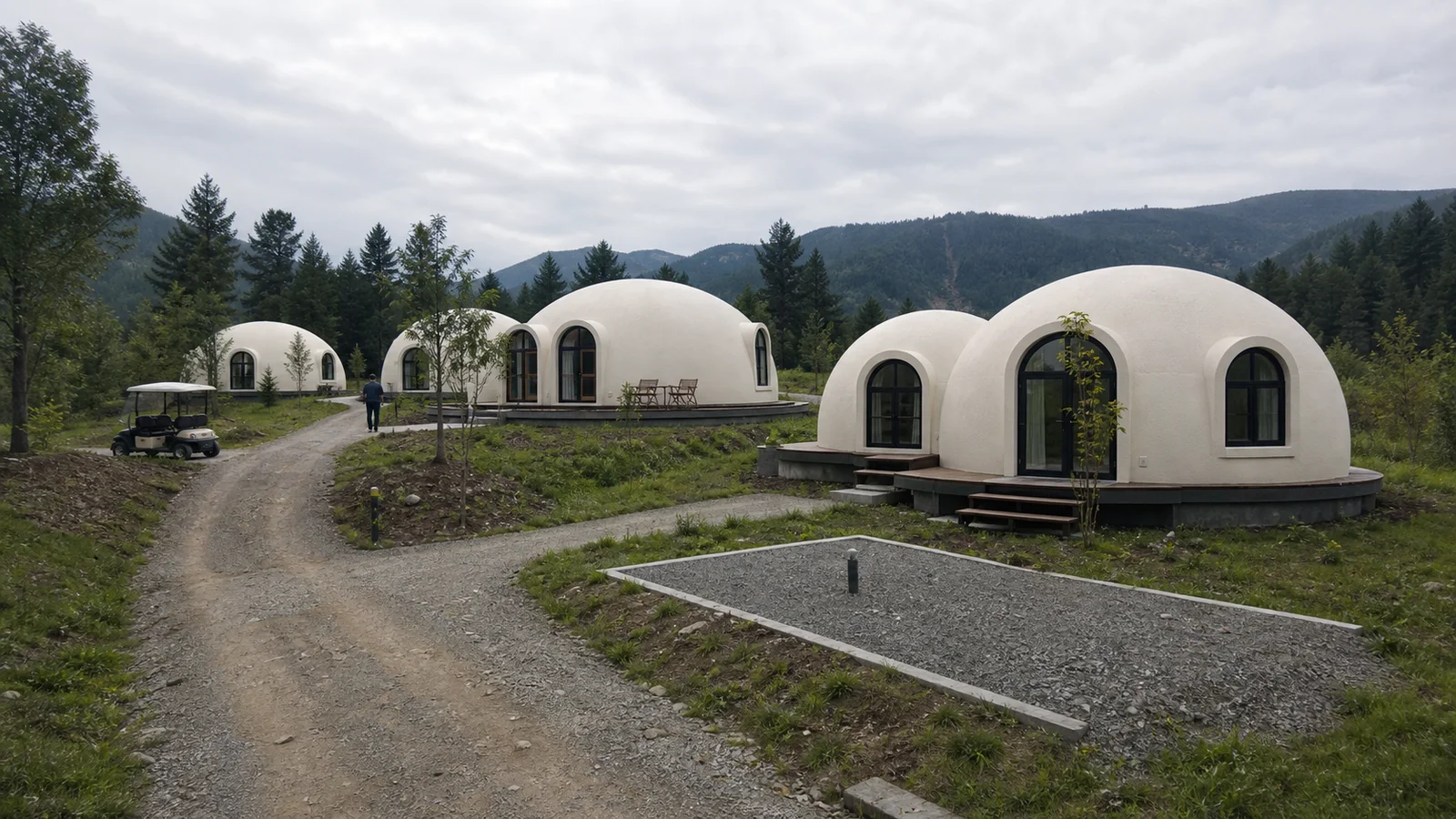
Resort developers and hotel-group project teams sourcing prefab EPS dome cabins for multi-unit glamping or tourism projects need a procurement reference — site planning math, SKU mix layouts, engineering connection scope, jurisdiction-specific compliance, multi-container logistics, and quote-tier language that lets two suppliers be compared on the same basis. This guide is that reference.
The Vaultwerk Dome Series ships in four standard footprints (28, 33, 40, and 44 m²). All standard sizes connect door-to-door on a common 1150 mm connection module, so mixed-SKU suites and clusters are standard planning options; connection-node design and multi-node layouts are engineering-reviewed per project, and connection is Dome-to-Dome only. Pricing is not published on this page — capex scope depends on unit count, scope tier, freight, foundation, and local installation, and is quoted per project; how EPS dome quotes are scoped explains the tiers and cost factors. What this guide publishes is the inputs: the procurement language, the engineering hedging boundary, and the third-party industry benchmarks that frame a resort revenue plan.
Request a project quote — share unit count, destination, intended use, and target scope tier.
Why prefab EPS dome cabins fit resort and glamping projects
Prefab EPS dome cabins fit resort and glamping projects because their insulated module envelope is engineered for permanent or long-lease holds, supports connected-suite layouts across all four standard footprints on a common 1150 mm connection module (node design reviewed per project), and ships in standard container-loaded shells against a procurement-grade scope language — three properties the dominant alternatives in the dome category do not all share.
Versus PVC fabric domes, EPS dome cabins replace the recurring fabric-cover replacement cycle with a structural insulated envelope designed for long-hold operation; see the full lifecycle cost breakdown in EPS vs PVC Dome TCO. Versus geodesic kit domes (triangulated panels at a fixed nominal diameter), the EPS modular system gives a buyer multiple standard footprints that connect door-to-door on a common module grid, rather than a single fixed-diameter geometry. Versus concrete monolithic domes (cast on a single inflated airform), the EPS modular system ships flat, assembles on interlocking joinery, and can be planned across phases. Versus US log cabin and prefab cabin systems (Zook, Plant Prefab, Den, Moliving), the dome geometry plus the EPS module-and-joinery system gives a distinct hero unit silhouette. Full product specifications are in the prefab dome house guide.
The market context supports the procurement case. MMCG Invest places glamping ADR positioning between midscale hotels ($130–165) and upscale boutique ($193–440), at a 4–7x premium over traditional camping ($35–65 per night).1 KOA’s 2025 report places glamping at 29 percent of all camping experiences in 2025, with glamper average daily spend at $251 per day.2 Among standard glamping unit types, Sage Outdoor Advisory reports dome accommodations averaging $257 per night nationally in Q2 2025 — the highest ADR among the unit types in that report (versus $217 for treehouses and $160 for cabins).3 Dome geometry is the highest-ADR standard glamping unit type in current US industry data; that is the procurement-side reason resort developers ask about dome SKUs in round one.
Resort planning math: unit count, footprint, container loads
Resort site planning resolves three inputs — total unit count, footprint distribution across SKUs, and container-shipment count — into a procurement brief the supplier can quote against without back-and-forth.
The table frames typical project sizes for the Vaultwerk Dome Series inquiry funnel. Numbers are reference ranges; exact per-container loading and assembly windows are project-specific.
| Project size | Typical units | Approx. site footprint (units only) | 40-foot HQ container loads | Shell-assembly reference window |
|---|---|---|---|---|
| Small camp | 5–20 units | ~140–880 m² across mixed SKUs | Several 40HQ shipments | Phased over weeks, overlapping crews |
| Resort / hotel project | 20–100 units | ~560–4,400 m² across mixed SKUs | Multi-container programme | Multi-month deployment, phased foundations |
| Tourism megaproject | 100+ units | 2,800 m² and above | Multi-shipment programme over months | Phased across master-plan stages |
The four standard footprints in the Dome Series are 28, 33, 40, and 44 m². Container loading varies by SKU footprint and packaging revision: smaller footprints load more units per 40-foot high cube container than larger or combined configurations. Export reinforcement framing — timber or steel — is required for most international destinations and is quoted as a separate line item.
Shell assembly time for the module-and-joinery system is approximately two hours per unit under controlled conditions for a trained crew. Real-project totals depend on foundation prep, crew size, weather, lifting equipment, and site access. Site coordination, supervisory support, and any factory crew secondment scope are confirmed in the quote rather than promised as a fixed assembly window.
Mix-and-match SKU layouts: site-planning patterns for resort developers
Mix-and-match in the Dome Series context works across all four standard footprints: units connect door-to-door on a common 1150 mm connection module, so a 28 + 40 m² suite, a twin 33 m² pair, or a mixed cluster are all plannable combinations. Connection-node design and multi-node cluster layouts are project-specific engineering reviews, not pre-published standard configurations. Browse the connectable layouts on the Dome Series product page.
The capability differentiates an EPS modular dome system from the alternatives. PVC fabric domes connect only through walkways, not at the envelope. Geodesic kits are geometry-locked at a fixed diameter and cannot interface a smaller and larger dome as one structural envelope without a custom engineering package. Concrete monolithic domes are cast as a single airform and are not reconfigurable after the cast cures. EPS modular domes ship flat, assemble on interlocking joinery, and connect across standard sizes on a common connection module, with node design and multi-node clusters held for engineering review.
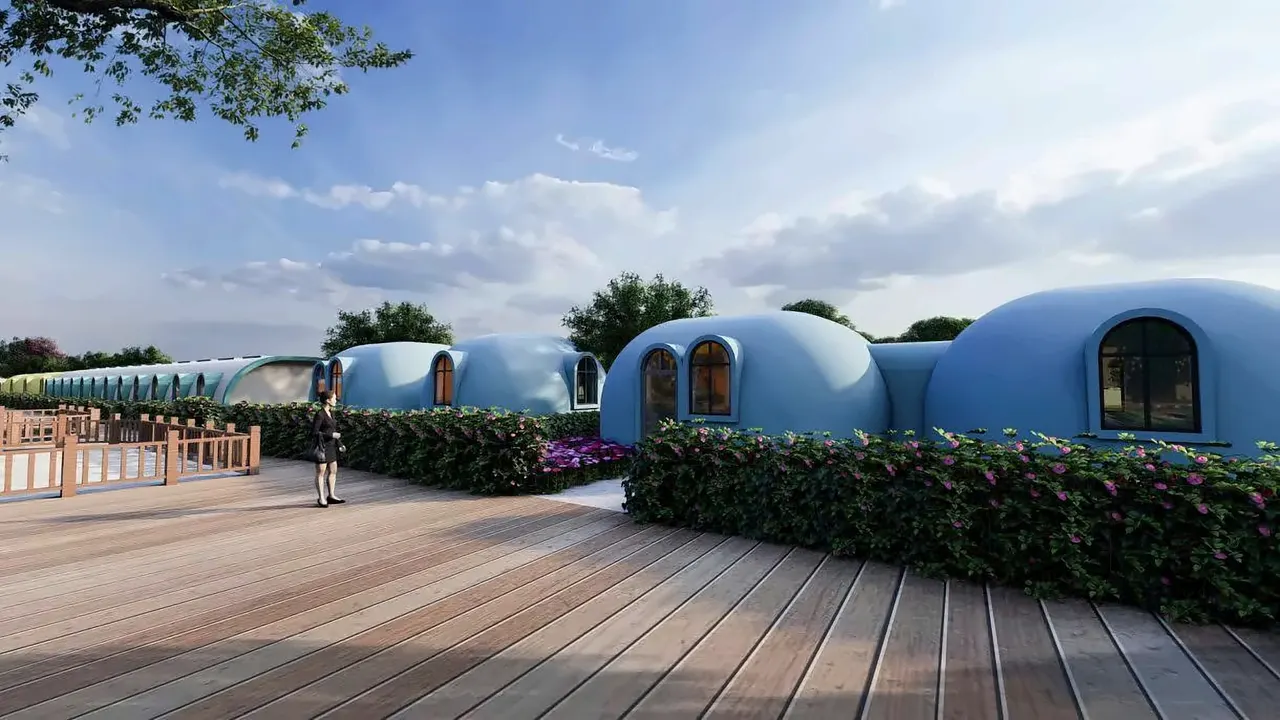
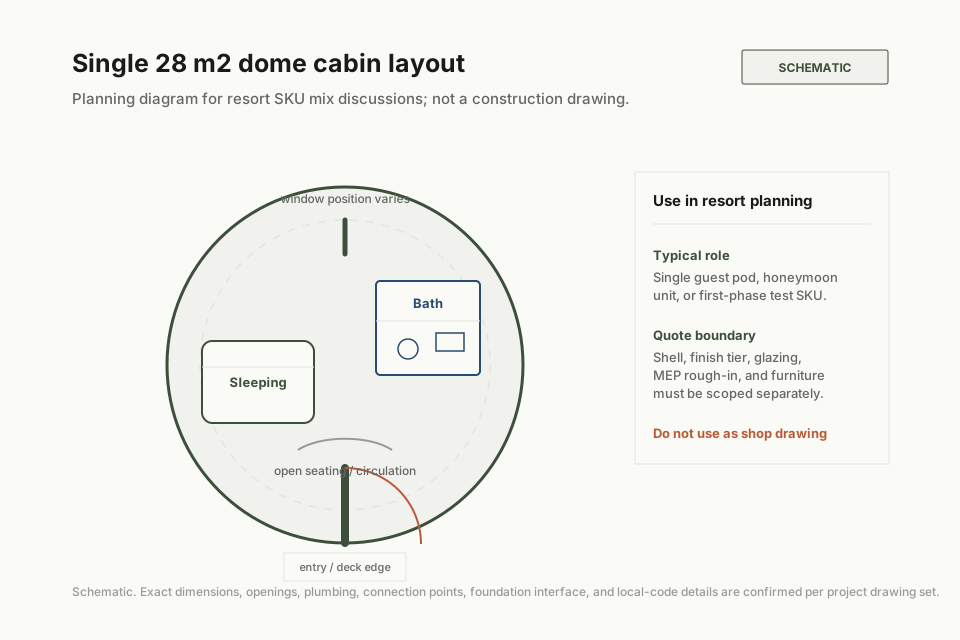
The site-planning patterns below are the layouts resort developers use the connection capability for in practice. Each is a design option to specify in the quote brief, not a fixed product configuration.
(a) Waterfront row. Single-SKU 28 or 33 m² units in a linear set-back from a lake or coast, each independent with a private deck. The connection capability earns its keep elsewhere in the same masterplan — the shared-core suite at the row endpoint often uses a 28 + 40 m² connected pair.
(b) Hillside terrace. Units stepped down a graded slope with grouped foundations, each independent at the envelope but sharing a utility loop and access path. Foundation prep is more involved than flat sites; quote scope should include foundation engineering as a separately quoted line.
(c) Radial cluster around a central hub. Four or more dome units in a radial pattern around a central hub used for reception, lounge, or wellness. A larger Dome Series unit (40 or 44 m²) can serve as a structurally connected hub on the same 1150 mm connection module; a Cabin Series or A-Series building can anchor the cluster as a separate freestanding structure, since box and A-frame products do not physically connect to domes. Hub-to-spoke connection-node design is the engineering-heavy element, reviewed per project.
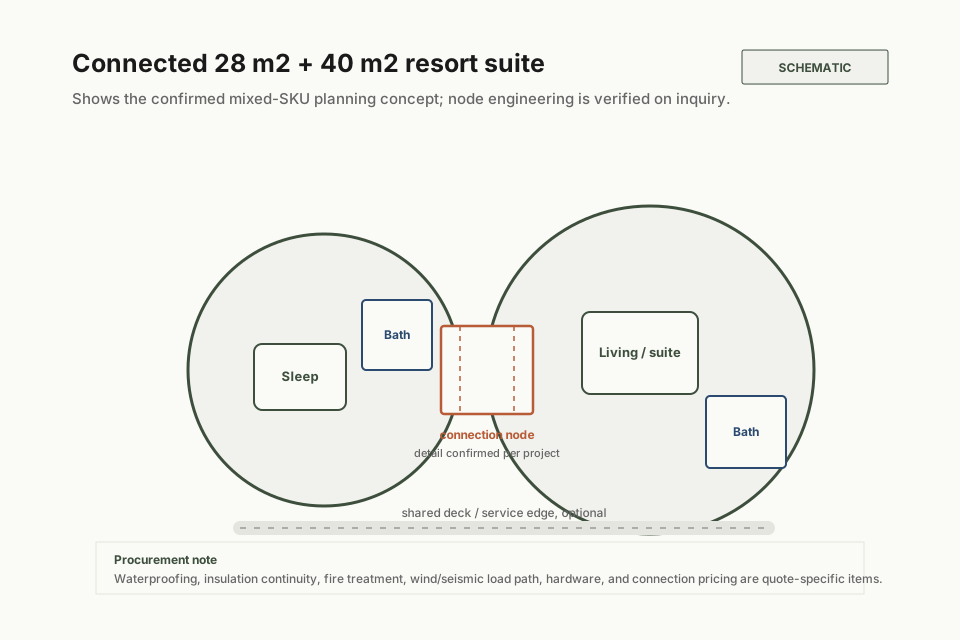
(d) Linear walkway. A run of mixed-SKU units linked by a covered walkway and tied into a shared service spine. Often used for honeymoon-and-suite clusters (a 28 m² unit physically connected to a 40 m² unit reads as one combined suite from inside).
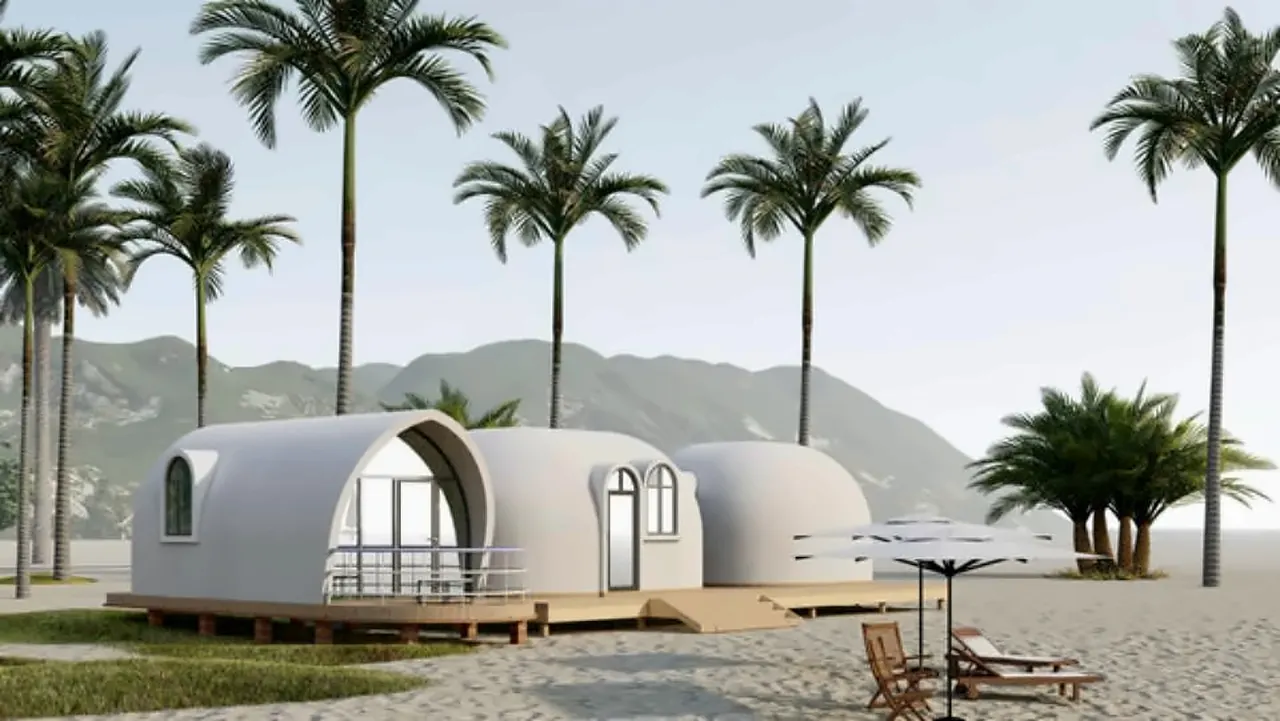
(e) Privacy zone separation. Multiple sub-clusters separated by terrain or planting buffers, each sub-cluster internally connected. Used where density must balance against guest perception of seclusion.
(f) Phased expansion grid. A site planned in two or three phases, with the first phase built as a free-standing cluster and later phases adding connected units against the same master plan. Phased delivery lets the operator validate ADR and occupancy on Phase 1 before committing capex on Phase 2.
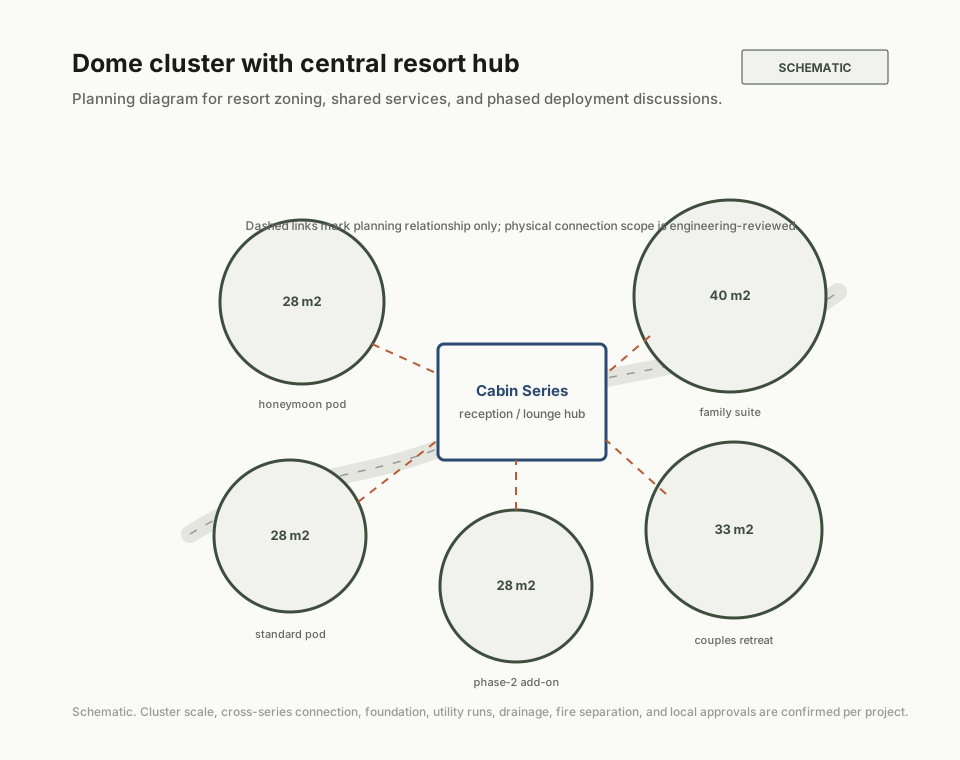
Site-specific drawings, connection-node specifications, foundation engineering, and any structural reinforcement at the cluster scale are project-specific items confirmed against the project brief.
Engineering connection nodes: what’s confirmed vs what’s project-specific
Engineering connection nodes are the interface between adjacent dome units at the structural envelope level — and the scope of what is factory-confirmed versus what is verified per project is the procurement question resort developers should ask in round one.
Already confirmed at the factory level. All standard Dome Series sizes (28, 33, 40, 44 m²) connect door-to-door on a common 1150 mm connection module, so mixed-size pairs and suites can be planned as a single multi-volume building; connection is Dome-to-Dome only. The base envelope module is a graphite-enhanced expanded polystyrene panel at 18 cm thickness with a closed-cell core, used across all standard Dome Series SKUs.4 The joinery system uses interlocking mortise-and-tenon-style detailing assembled on site, with mesh, mortar, and exterior coating as finish layers.
Confirmed per project, not pre-published. Four categories of node detail are confirmed against the project brief:
- Waterproofing at the junction. Flashing detail, sealant selection, drainage path, and membrane continuity between adjacent envelopes are project-specific, confirmed against site climate and assembly tier.
- Insulation continuity. Thermal-bridge detailing at the node, declared U-value of the combined envelope, and internal-side detailing are confirmed per project against the destination climate zone.
- Fire detailing. GB 8624 B1 classification applies to the module material itself; assembly-level fire performance at a node depends on destination jurisdiction review and may require local tests or engineering evidence such as ASTM E84 surface-burning data, NFPA 285 exterior-wall assembly testing where triggered, EN 13501-1 evidence in Europe, or AS/NZS pathways in Australia.
- Wind and seismic load at the cluster scale. Factory documentation references resistance for single-unit envelopes; a cluster’s load path, foundation tie-in, and any reinforcement at the node scale are confirmed by a local engineer in the destination jurisdiction.
Connection node specifications are available on inquiry; the manufacturing engineering team confirms node detailing, hardware, and any structural reinforcement against the specific cluster layout.
Product portfolio for resort layouts: Dome / Cabin / A-Series
Vaultwerk operates three product series under one umbrella brand, and a resort master plan typically draws on more than one — the Dome Series as the hero guest unit, the Cabin Series as service and staff buildings, and the A-Series as an alternative premium suite format. Mix-and-match within the Dome Series is engineering-confirmed across all standard sizes on a common 1150 mm connection module; the three series do not physically connect to each other, so cross-series layouts are planned as separate freestanding buildings.
| Series | Format | Typical resort role |
|---|---|---|
| Vaultwerk Dome Series | EPS modular dome, 18 cm graphite-enhanced EPS module, four footprints (28 / 33 / 40 / 44 m²) | Hero guest unit; signature silhouette as brand-asset photograph; supports honeymoon-pair and cluster suite layouts |
| Vaultwerk Cabin Series | Box-type prefab cabin (factory-built modular cabin) | Staff dormitory, back-of-house service, reception or lounge hub, central facilities |
| Vaultwerk A-Series | A-frame triangular cabin, often two-storey | Premium two-storey suite as alternative to a connected dome pair; family or extended-stay use |
For most resort projects, the question is not “Dome or Cabin or A-Series” but which mix of all three lands the brief. A typical 30–50 unit resort masterplan might allocate 20–30 Dome Series units as guest accommodation, 4–8 Cabin Series modules for back-of-house and service, and 2–4 A-Series units as premium suites — with the exact ratio confirmed against ADR target, seasonal occupancy, and the operator’s staffing model.
Cross-series connection scope (Dome to Cabin, Dome to A-Series, or three-series clusters) is confirmed per project. This guide covers the Dome Series in depth; Cabin Series and A-Series guides will follow.
Compliance and local approval: factory document scope and what your jurisdiction still requires
An SGS RoHS / material-safety report and a China GB 8624 B1 fire report do not equal US, UK, Irish, or Australian local approval — they form an evidence base for a local code consultant’s review, not a substitute for destination-specific certification. CE / EU DoC is not used as a public claim until original EU documents are verified. The current document status is published on the evidence & spec brief page. Each jurisdiction has its own pathway, handled per project rather than bundled in the base shell quote.
United States. Many short-stay glamping cabins are reviewed under transient lodging logic, but the final occupancy classification belongs to the authority having jurisdiction and the local code consultant.5 For foam plastic, IBC 2024 Chapter 26 separates surface-burning evidence, thermal-barrier treatment, and exterior-wall assembly behavior: §2603.3 uses ASTM E84 / UL 723 surface-burning indices for foam plastic; §2603.4 addresses thermal barriers; and exterior-wall conditions can trigger assembly-level review such as NFPA 285, which is a full exterior-wall assembly test, not a component certificate.6 Vaultwerk’s current GB 8624 B1 fire report and SGS RoHS evidence should be treated as a document pack for local review, not as proof of US code approval (CE / EU DoC is not claimed until verified).
United Kingdom. England building-control review for short-stay holiday accommodation usually needs the Approved Document B Volume 2 route rather than a domestic-only lens.7 Planning is separate from building control: the 2023 GPDO Class BC created a 60-day temporary recreational campsite right, but local authority guidance treats non-moveable glamping pods, geo-domes, shepherd huts, and luxury lodges as likely to need planning permission.8 For fixed prefab dome cabins, buyers should assume a site-specific planning check from the outset instead of relying on temporary campsite rights.
Ireland. Do not rely on a generic “45 m² exemption” for tourism dome projects. The S.I. No. 649/2025 source previously reviewed for this draft concerns agricultural exempted development, while the Government’s 2026 planning-exemption announcement concerns residential extensions and smaller homes, not glamping accommodation.9 Tourism dome projects should be routed through local planning advice, Fáilte Ireland Outdoor Accommodation Toolkit alignment, and the Short-Term Letting Register pathway where applicable.10
Australia, Canada, New Zealand, and other destinations. Australia requires NCC compliance plus AS/NZS 3959 BAL assessment in bushfire zones; Canada uses CSA A277 for factory certification and ULC-S102 for surface burning; New Zealand uses NZBC pathways. Each destination is handled per project against the local engineer of record and the AHJ. See the prefab dome house guide’s compliance chapter for the full multi-destination frame.
Vaultwerk coordinates handover of factory certification documents and introduces buyers to destination-side compliance consultants. We do not guarantee destination compliance — that requires the buyer’s local code consultant, a registered engineer, and a local permit from the authority having jurisdiction.
Container logistics and site assembly for multi-unit deployments
Multi-unit logistics for a resort-scale Dome Series order covers the chain from factory pickup in China through FOB or CIF loading, ocean freight, customs and inland transport, and on-site sequencing of foundation, shell assembly, utilities, and finishing across overlapping crews. Each link is destination-specific, and the quote scope determines which links sit with Vaultwerk and which with the buyer.
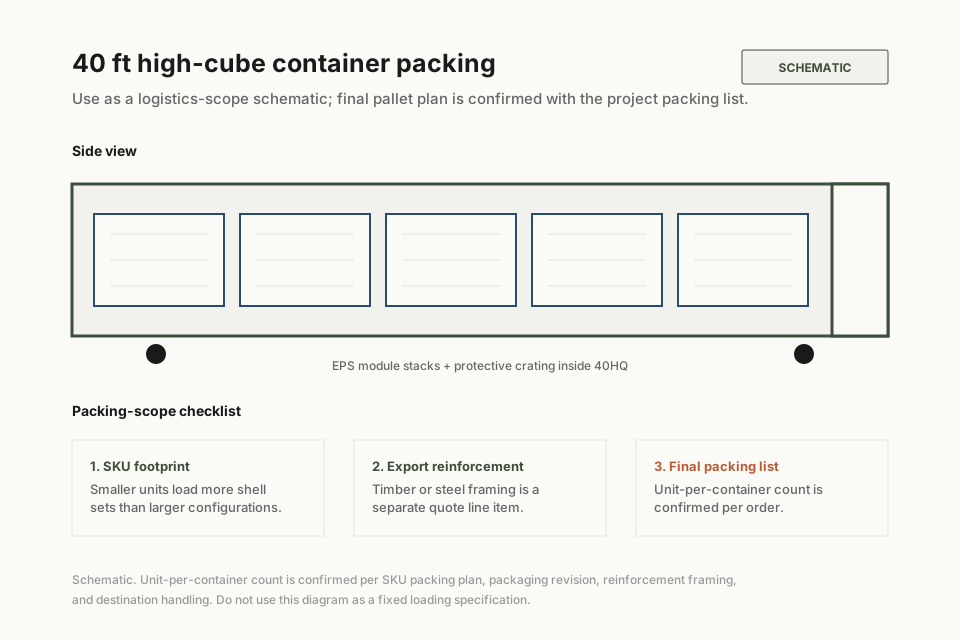
Container loading at resort scale. Dome Series shells ship in standard 40-foot high cube containers. Per-SKU loading varies with footprint, packaging revision, and any export reinforcement framing — smaller footprints load more units per container than larger ones, and combined configurations load fewer.11 For a 50–100 unit resort order, the practical implication is a multi-shipment programme sequenced against the destination port’s handling capacity and the on-site readiness of each phase.
Export reinforcement packaging. Timber or steel reinforcement framing is required for most international destinations beyond regional shipping and is quoted as a separate line item, not included in the base shell price. Resort developers should ask suppliers to itemise export packaging in the quote — that line item is one of the easier places for two quotes to drift out of comparison.
Multi-unit site sequencing. A 20–100 unit resort deployment is typically planned as overlapping workstreams rather than one-unit-at-a-time: foundation preparation, freight sequencing, shell assembly, utility trenching, and finishing can run in parallel where the local contractor and site conditions allow it. Sequencing depends on site access, lifting equipment, crew size, weather windows, and destination approvals, and is coordinated with the destination project partner when that scope is included in the quote.
Lead time is project-specific. Total lead time from order confirmation to operational opening day is quoted per project after Vaultwerk confirms unit count, SKU mix, destination port, scope tier, and any destination-specific certification testing. Resort developers should issue a project brief covering all five inputs in the inquiry; Vaultwerk routes the response within one business day.
Revenue planning framework for glamping operators
A revenue planning framework builds annual revenue from four inputs — average daily rate, occupancy, nights available, and unit count — applied against third-party industry benchmarks. The framework below sources its benchmarks from independent industry data, not Vaultwerk’s own pricing — supplier-side capex is quoted per project via inquiry, not published.
The operator-side formula.
Annual revenue = ADR × occupancy × nights available × unitsADR benchmarks (third-party industry data). Sage Outdoor Advisory’s Q2 2025 report places dome accommodations at $257 per night nationally in the US — the highest ADR among standard unit types in that report, ahead of treehouses ($217) and cabins ($160).3 Industry-wide ADR across all glamping unit types reached $251 per night in 2025, up 21 percent from $207 in 2023 and 11 percent year-on-year, per Cairn Consulting Group’s 2025 US Glamping Industry Report.12 MMCG Invest places overall glamping ADR positioning between midscale hotels ($130–165) and upscale boutique hotels ($193–440), at a 4–7x premium over traditional camping ($35–65 per night).1
Occupancy benchmarks. Seasonal occupancy patterns across US glamping operators show peak of 70–90 percent (June–August), shoulder of 45–65 percent, and off-season of 15–35 percent, with roughly 63 percent of US glamping sites operating year-round.13 High-performing sites cluster toward the upper end.
Demand-side context. The KOA 2025 report places glamping at 29 percent of all camping experiences in 2025 (and 31 percent of new campers), with glamper average daily spend at $251 per day.2
Capex side: quoted per project. Unit cost, freight, foundation, on-site installation, and any destination-specific certification testing depend on unit count, SKU mix, destination, scope tier (shell-only, ready-to-move-in, or turnkey), and any project-specific OEM scope. Vaultwerk quotes per project against the inquiry brief — see the quote-scope chapter for the language to use.
Actual returns depend on location, brand, season, and operations. The third-party benchmarks above are industry data, not a forecast for any specific project. Resort developers should run their own pro forma against the destination market, brand positioning, season length, and operating model before committing capex.
For Resort Developers / For Tourism Projects: regional notes
Regional resort and tourism project context across three batches frames where prefab EPS dome cabins fit into the public master-plans, brand pipelines, and supplier-engagement portals that resort developers and tourism authorities have made visible in 2026.
North America glamping resorts (US and Canada)
Hotel groups have moved on glamping at the brand-acquisition layer. Marriott acquired the Postcard Cabins brand in December 2024 (29 properties, 1,200+ cabins); Hilton announced an AutoCamp partnership in February 2024; Hyatt opened a World of Hyatt alliance with Under Canvas across 13 US locations in July 2024. These moves frame glamping as an institutional asset class — and that institutionalisation is the procurement environment a resort developer is now selling into. The KOA 2025 finding that glamping is 29 percent of all camping experiences in 2025 and 31 percent of new campers2 is the demand-side companion. Canada-specific compliance pathways (CSA A277, ULC-S102) are in the prefab dome house guide.
Europe boutique camps (UK, Ireland, and beyond)
UK boutique camp development runs through local planning checks and Approved Document B Volume 2 pathways covered in the compliance chapter above. The practical procurement note is simpler than the statutory detail: fixed pods, geo-domes, and lodge-style units should be scoped as planning-review items from the outset, not treated as ordinary temporary campsite pitches.8 Ireland’s tourism dome projects should likewise be routed through local planning advice plus Fáilte Ireland Outdoor Accommodation Toolkit alignment and STLR review where applicable.9 Wider European context (Greece, Croatia, Cyprus, Italy) follows the same general logic — CE marking is necessary but not sufficient.
Middle East and Central Asia tourism projects
Saudi Arabia’s tourism programme is relevant to resort procurement because Vision 2030 targets 150 million annual visits by 2030, while third-party hospitality research reports a large hotel pipeline concentrated in upper-tier segments.14
For this page, the useful buyer point is not a full giga-project news digest. It is that Gulf resort and desert-hospitality projects already use dome-format accommodation as a premium visual language, while every live project still requires local fire, structural, thermal, and procurement approval.15
Supplier-engagement path for Vision 2030 projects. Vendors and suppliers can register through the live Red Sea Global Vendor Registration portal and the live NEOM Suppliers Portal; the two giga-projects operate separate vendor systems requiring independent registration.16 KSA-specific fire and building code compliance (Saudi Building Code, SBC 801) is handled per project alongside the supplier-registration track.
Central Asia. Central Asia remains a future resort-development research track for Vaultwerk because tourism infrastructure and outdoor accommodation are expanding unevenly across Kazakhstan, Uzbekistan, and neighboring markets.17 For now, treat this as a future market-development and due-diligence conversation, not a published case-study claim. Large regional resort projects are handled through a dedicated project-procurement path; English-language evidence and supplier due diligence are available on inquiry.
Quote scope tiers and inquiry path for resort projects
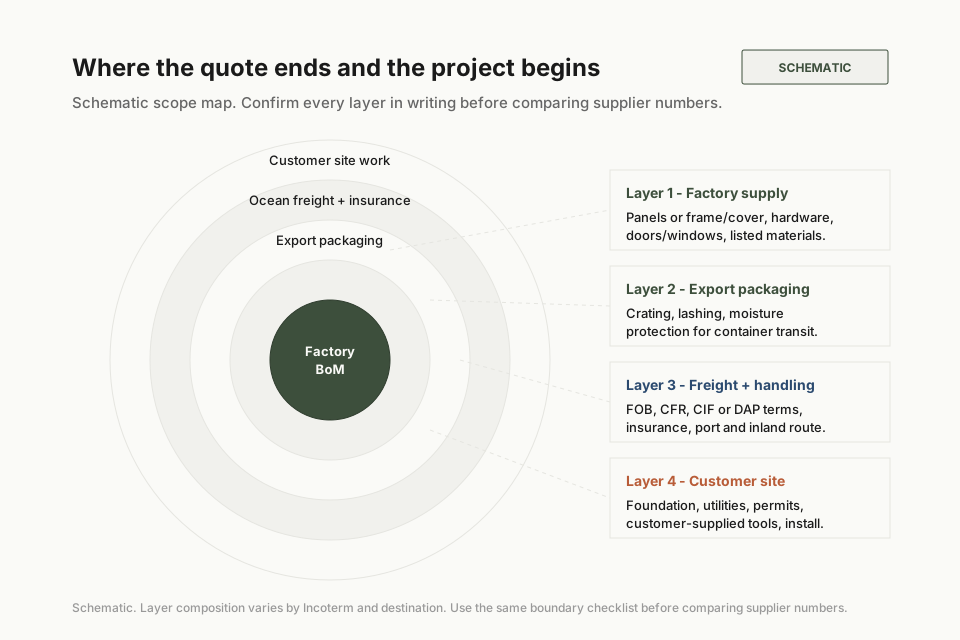
Quote scope at resort scale is more than the three standard tiers (shell-only, ready-to-move-in, turnkey) — it is also a set of multi-unit coordination decisions that change which line items sit with Vaultwerk and which with the buyer-engaged local project partner. Resort developers should specify both the scope tier and the multi-unit coordination scope in the inquiry brief.
| Inclusion item | Shell-only | Ready-to-move-in | Turnkey |
|---|---|---|---|
| EPS modules, joinery, mesh, mortar, exterior coating | Yes | Yes | Yes |
| Factory-issued documentation (GB 8624 B1 fire report + SGS RoHS) | Yes | Yes | Yes |
| Glazing per project drawing | Buyer-supplied | Yes | Yes |
| Basic interior finishes | Buyer-supplied | Yes | Yes |
| Electrical and plumbing rough-in to factory layout | Buyer-supplied | Yes | Yes |
| Sanitary fixture rough-in | Buyer-supplied | Yes | Yes |
| On-site assembly with factory supervisory support | Buyer-arranged | Buyer-arranged | If specifically quoted |
| Multi-unit site coordination (sequencing across phases) | Buyer-arranged | Buyer-arranged | Coordinated with local partner |
| Foundation engineering and pour | Buyer-arranged | Buyer-arranged | Coordinated with local partner |
| Destination-specific certification testing and approvals | Buyer-arranged | Buyer-arranged | Coordinated with local partner |
| Local utility connections to the unit boundary | Buyer-arranged | Buyer-arranged | Buyer-arranged |
| HVAC unit supply and commissioning | Buyer-arranged | Buyer-arranged | Coordinated with local partner |
| FF&E and operational furniture | Buyer-arranged | Buyer-arranged | Buyer-arranged |
| Land, operating licences, project design | Buyer-arranged | Buyer-arranged | Buyer-arranged |
Each tier is a scope definition — what is included — not a price band. Two suppliers cannot be compared on the same basis until both are quoting the same tier against the same buyer-supplied items list.
New-project quote is not a resale listing. Searches such as “dome house for sale” often lead to existing homes, real-estate listings, DIY kits, or one-off used inventory. A resort developer is solving a different problem: unit count, SKU mix, phased delivery, scope tier, destination port, foundation responsibility, local approval, and multi-unit site coordination. Treat Vaultwerk’s quote as a new-project procurement scope, not a Zillow-style listing price. For modular dome home kits and what a factory shell package includes, start with the prefab dome house guide before comparing suppliers.
Resort-specific scope variables beyond the three tiers. Multi-unit foundation coordination (one foundation engineer of record for the cluster versus per-unit), phased delivery scheduling (Phase 1, Phase 2, Phase 3 spaced months or years apart), shared utility runs (one trunk loop versus per-unit hook-ups), and site survey scope (one combined survey versus phased per-unit) each shift the quote scope. Resort developers should specify all four in the inquiry.
Unit-count tiered inquiry path. The Vaultwerk inquiry form routes by unit count into four tiers:
- 1–5 units: small operator or single guest unit; Vaultwerk handles directly.
- 5–20 units: small camp or boutique site; Vaultwerk handles directly with production and export coordination.
- 20–100 units: resort or tourism project; routed through resort-procurement scope, often with factory engineering review for cluster layouts.
- 100+ units: tourism megaproject or master-planned destination; handled through a dedicated large-project procurement path with English-language evidence and due-diligence support.
Request a project quote — share unit count, destination, intended use, and target scope tier.
Related guides
- Prefab Dome House Guide — Full product specifications, SKU range, and certifications.
- EPS vs PVC Dome TCO — 10-year lifecycle cost comparison for permanent resort holds.
Request a project quote
Share your unit count, destination, intended use, and target scope tier. Vaultwerk routes each inquiry to the right quote path within one business day.
Footnotes
-
MMCG Invest, “The U.S. Glamping Industry Enters Its Institutional Era.” https://www.mmcginvest.com/post/the-us-glamping-industry-enters-its-institutional-era (accessed 2026-05-31). ↩ ↩2
-
KOA, “2025 North American Camping and Outdoor Hospitality Report.” https://www.koapressroom.com/press/2025-camping-outdoor-hospitality-report/ (accessed 2026-05-31). ↩ ↩2 ↩3
-
Sage Outdoor Advisory, “Glamping Market Trends 2025,” Q2 2025 report covering unit-type ADR (domes $257, treehouses $217, cabins $160). https://sageoutdooradvisory.com/blog/glamping-market-trends-2025/ (accessed 2026-05-31). ↩ ↩2
-
Vaultwerk Dome Series product source pack — the bilingual model manual and production-side BoM / floor-plan materials reviewed in May 2026. Used here only for SKU footprints, 18 cm module thickness, and the Dome Series connectability claims (door-to-door connection on a common 1150 mm module, confirmed in manufacturer replies recorded June 2026); connection-node performance remains project-specific. ↩
-
ICC Digital Codes, “International Building Code 2024 — Chapter 3, Section 310 Residential Group R-1,” and UpCodes mirror for IBC 2024 transient occupancy definition. https://codes.iccsafe.org/content/IBC2024P1/chapter-3-occupancy-classification-and-use / https://up.codes/s/residential-group-r-1 (accessed 2026-05-31). ↩
-
ICC Digital Codes, “International Building Code 2024 — Chapter 26 Plastic, Sections 2603.3–2603.5”; ICC, “2024 Group A Proposed Changes to the I-Codes — Fire Safety,” showing foam-plastic ASTM E84 / UL 723 surface-burning indices; and NFPA, “NFPA 285 Standard Fire Test Method for Evaluation of Fire Propagation Characteristics of Exterior Wall Assemblies Containing Combustible Components.” https://codes.iccsafe.org/content/IBC2024P1/chapter-26-plastic / https://www.iccsafe.org/wp-content/uploads/IBC-Fire-Safety-2024.pdf / https://www.nfpa.org/product/nfpa-285-standard/p0285code (accessed 2026-05-31). ↩
-
UK Government, “Approved Document B (Fire Safety) — Volume 1 Dwellings and Volume 2 Buildings Other Than Dwellings, 2019 edition with 2020, 2022, 2025, 2026, and 2029 amendments.” https://www.gov.uk/government/publications/fire-safety-approved-document-b (accessed 2026-05-31). ↩
-
legislation.gov.uk, “The Town and Country Planning (General Permitted Development etc.) (England) (Amendment) Order 2023,” which inserted Class BC temporary recreational campsites; Cornwall Council, “Planning guidance for temporary campsites,” noting that non-moveable glamping pods, shepherd huts, geo-domes, and luxury lodges are likely to need planning permission. https://www.legislation.gov.uk/uksi/2023/747/pdfs/uksi_20230747_en.pdf / https://www.cornwall.gov.uk/planning-and-building-control/planning-enforcement/temporary-pop-up-camping-sites-planning-guidance/ (accessed 2026-05-31). ↩ ↩2
-
irishstatutebook.ie, “Planning and Development (Exempted Development) (No 2) Regulations 2025 (S.I. No. 649/2025),” which concerns agricultural exempted development; Department of Housing, Local Government and Heritage, “Government announces changes to Planning Exemptions Regulations,” covering 2026 proposed changes for residential extensions and smaller homes. https://www.irishstatutebook.ie/eli/2025/si/649/made/en/pdf / https://www.gov.ie/en/department-of-housing-local-government-and-heritage/press-releases/government-announces-changes-to-planning-exemptions-regulations/ (accessed 2026-05-31). ↩ ↩2
-
Fáilte Ireland, “Outdoor Accommodation Toolkit,” and Fáilte Ireland, “Short-Term Letting Register (STLR)” under the Short Term Letting and Tourism Bill 2025. https://www.failteireland.ie/Product-development/Developing-Outdoor-Accommodation.aspx / https://www.failteireland.ie/registration-and-grading/short-term-letting-register-(STLR).aspx (accessed 2026-05-31). ↩
-
Vaultwerk Dome Series factory packing reference held on file, cross-checked against the Chinese-English product manual container loading notes. Per-SKU loading varies by footprint, packaging revision, export reinforcement, and destination port handling; exact counts are confirmed per quote. ↩
-
Modern Campground, “Glamping ADR Hits $251/Night as Guest Stays Lengthen, Amenities Evolve — Insights from Glamping Show Americas 2025,” citing Cairn Consulting Group’s 2025 US Glamping Industry Report. https://moderncampground.com/usa/colorado/glamping-adr-hits-251-night-as-guest-stays-lengthen-amenities-evolve-insights-from-glamping-show-americas-2025 (accessed 2026-05-31). ↩
-
Cairn Consulting Group 2025 US Glamping Industry Report (via secondary aggregator citations) and MMCG Invest, on seasonal occupancy patterns and year-round operator share. https://moderncampground.com/usa/colorado/glamping-adr-hits-251-night-as-guest-stays-lengthen-amenities-evolve-insights-from-glamping-show-americas-2025 / https://www.mmcginvest.com/post/the-us-glamping-industry-enters-its-institutional-era (accessed 2026-05-31). ↩
-
Saudi Tourism Authority, “Tourism Sector in Saudi Vision 2030,” and Knight Frank Saudi Arabia, “Saudi Arabia Hospitality Market Review — 2025.” https://www.sta.gov.sa/en/vision2030/ / https://www.knightfrank.com.sa/en/newsroom/article/2025/5/saudi-arabia-hospitality-market-review---2025 (accessed 2026-05-31). ↩
-
Dubai City Tourism, “Al Marmoom Desert Reserve Guide,” and Al Marmoom Domes booking site, documenting an operational dome-format desert glamping product in the UAE. https://www.dubaicitytourism.com/al-marmoom-desert-reserve-guide/ / https://almarmoomdomes.com/ (accessed 2026-05-31). Cited as a regional market signal — not a Vaultwerk customer claim. ↩
-
Red Sea Global, “Vendor Registration,” and NEOM, “Our Business — Suppliers.” https://www.redseaglobal.com/en/vendor-registration/ / https://www.neom.com/en-us/our-business/suppliers (accessed 2026-05-31). ↩
-
Euronews, “China Set New Records in Trade and Investment in Central Asia in 2025,” and Middle East Forum, “China’s Foreign Investment Jumps as Beijing Bypasses Iran and Russia.” https://www.euronews.com/2026/04/15/china-set-new-records-in-trade-and-investment-in-central-asia-in-2025 / https://www.meforum.org/mef-observer/chinas-foreign-investment-jumps-as-beijing-bypasses-iran-and-russia (accessed 2026-05-31). ↩
Buyer Questions
How many EPS dome cabins fit in a 40-foot high-cube container for a resort shipment?
Vaultwerk Dome Series shells ship in 40-foot high cube containers, but exact unit-per-container counts are not published as a fixed specification. Loading varies by SKU footprint, current packaging revision, export reinforcement framing, and destination port handling, and is confirmed on each quote against the project's packing plan. Export reinforcement framing — timber or steel — is required for most international destinations and is quoted as a separate line item, not included in the base shell scope.
Can different dome sizes be physically connected into one resort layout?
Yes. Dome Series layouts connect door-to-door using a common 1150 mm connection module, so 28, 33, 40, and 44 m² units can be combined into linked suites, twin layouts, and clusters rather than placed adjacent on the same deck. This is the differentiating feature versus fabric domes (which connect only through walkways) and geodesic kits (which are geometry-locked at a fixed diameter). Connection-node design is reviewed per project. Connection is Dome-to-Dome only: Cabin Series and A-Series units do not physically connect to domes.
What's the difference between shell-only, ready-to-move-in, and turnkey scope for a resort project?
Shell-only covers EPS modules, structural joinery, mesh and mortar, exterior coating, and factory-issued documentation — the buyer arranges foundation, utilities, glazing, interiors, assembly labour, and certification. Ready-to-move-in adds basic interior finishes, basic electrical and plumbing rough-in to factory layout, glazing per drawing, and sanitary fixture rough-in. Turnkey is not a default package: when specifically quoted, it can add on-site assembly coordination with factory supervisory support and a buyer-engaged local project partner; foundation works and destination-specific certification remain separately scoped. Each tier is a scope definition — what is included — not a price band. Two suppliers quoting different tiers cannot be compared on the same basis until scopes are aligned.
Are resort dome units sold as kits or fully assembled?
For resort projects, Vaultwerk treats dome units as project-scoped shell packages or ready-to-move-in scopes, not consumer DIY kits. A shell package can include EPS modules, joinery, mesh, mortar, coatings, factory documentation, and doors or windows where specified. Fully assembled or operational-ready delivery depends on the quoted scope tier and usually still requires buyer-side foundation, utilities, local labour, permits, site access, HVAC commissioning, FF&E, and destination-specific certification work.
Do prefab EPS dome cabins meet US / UK / Australian building codes?
Our SGS RoHS / material-safety report and China GB 8624 B1 fire report do not equal US, UK, Irish, or Australian local approval, and CE / EU DoC is not claimed as a public certification until original EU documents are verified. Each jurisdiction requires its own approval pathway: US projects need local AHJ review for occupancy classification, ASTM E84 surface-burning evidence, thermal-barrier treatment, and assembly-level exterior-wall testing such as NFPA 285 where required; UK and Irish projects need local planning and building-control review for fixed short-stay accommodation; Australia requires NCC compliance and AS/NZS 3959 BAL assessment in bushfire zones. Jurisdiction-specific testing is handled per project, not bundled in the base shell quote.
How long does on-site assembly take for a 20-unit dome resort?
Factory reference documentation describes rapid shell-assembly times for trained crews under controlled conditions — roughly two hours per unit for the structural module-and-joinery system itself. Real-project totals for a 20-unit resort depend on foundation prep status, crew size and experience, weather, site access, lifting equipment, utility coordination, and the certification work running in parallel. Multi-unit sequencing typically rolls foundation pours, shell assembly, utility loops, and finishing work across overlapping crews rather than completing one unit before starting the next. Site coordination scope, supervisory support, and any factory crew secondment are scoped per project in the quote rather than promised as a fixed total.
What ADR or occupancy ranges do third-party sources report for glamping dome resorts?
Third-party industry data places the 2025 US glamping average daily rate at roughly $251 per night (Cairn Consulting via Modern Campground), with dome accommodations specifically averaging around $257 per night nationally (Sage Outdoor Advisory Q2 2025) — the highest ADR among standard glamping unit types in that report. MMCG Invest places glamping ADR between midscale hotels ($130–165) and upscale boutique hotels ($193–440), at a 4–7x premium over traditional camping. Industry data shows seasonal occupancy of 70–90 percent at peak (June–August), 45–65 percent in shoulder, and 15–35 percent off-season. These figures are external benchmarks for sizing a revenue plan; actual returns depend on location, brand, season, and operations.
Are EPS dome cabins suitable for Middle East climates (high heat, sand)?
The Vaultwerk Dome Series envelope uses graphite-enhanced expanded polystyrene modules with a closed-cell core structure — the same material family deployed across hot-climate construction globally — combined with an exterior mortar, mesh, and coating layer designed to shield the foam core from UV, abrasion, and surface heat. Whether a specific desert or Gulf site meets local thermal, fire, sand-erosion, and structural code requirements is a project-specific question that the manufacturing engineering team confirms against a destination brief, and that a local engineer signs off in the destination jurisdiction. Vaultwerk provides factory documentation and product data sheets to support that local review; we do not warrant performance outside it.
What lead time should a resort developer plan for a 50-100 unit order from China?
Lead time for a 50–100 unit Dome Series order is quoted per project after Vaultwerk confirms unit count, SKU mix, destination port, scope tier (shell-only, ready-to-move-in, or turnkey), and any destination-specific certification testing required. The factory production rhythm, container packing schedule across multiple 40-foot high cube shipments, ocean freight transit, destination port handling and customs clearance, inland freight, and on-site assembly sequencing each contribute to the total — and each is destination-specific. Resort developers should issue a project brief with unit count, destination, intended use, and target scope tier, and Vaultwerk routes the inquiry to a project-specific lead time within one business day.