dome house cost
Glamping Dome Cost: EPS vs PVC 10-Year Lifecycle Comparison
Compare glamping dome cost and dome house cost across EPS modular and PVC fabric domes by kit scope, lifecycle cost, maintenance, replacement, and downtime.
If you are pricing a glamping dome, dome house, or prefab dome kit, the first quote is only the starting point. A small to mid-size PVC fabric dome often looks cheaper than an EPS modular dome at day one, but that number can hide scope gaps that matter over a resort hold.
For a multi-unit resort, the useful comparison is dome house cost over time: quote scope, kit inclusions, export packaging, freight, foundation, installation, maintenance, cover replacement, downtime, and energy load. Once those variables are modelled across a 10-year hold, the cheaper day-one product can become the more expensive operating asset.
This guide is written for resort developers, hospitality project teams, and dealers screening dome suppliers before an RFQ. It is not a checkout-price article. If you are testing one seasonal pop-up dome for a six-month campaign, PVC fabric may be the better tool. If you are planning 5, 20, or 100 units on permanent or long-lease land, build the comparison with quote-scope parity before selecting a supplier.
Vaultwerk manufactures EPS modular dome systems in China. We quote by project: unit count, destination, scope tier, certification requirements, and responsibility boundaries. Use this article as a procurement worksheet before requesting a quote. For how those scope tiers and cost factors are structured into an actual quote, see how EPS dome quotes are scoped; the factory document status behind the EPS side (fire classification, material-safety report, floor plans, loading references) is listed on the evidence & spec brief.
For a full product overview of EPS dome systems — engineering specs, SKU sizes, kit boundaries, connectable layouts, certifications, and quote scope — see our prefab dome house guide.
Request Quote — or use the checklist below before you contact any vendor.
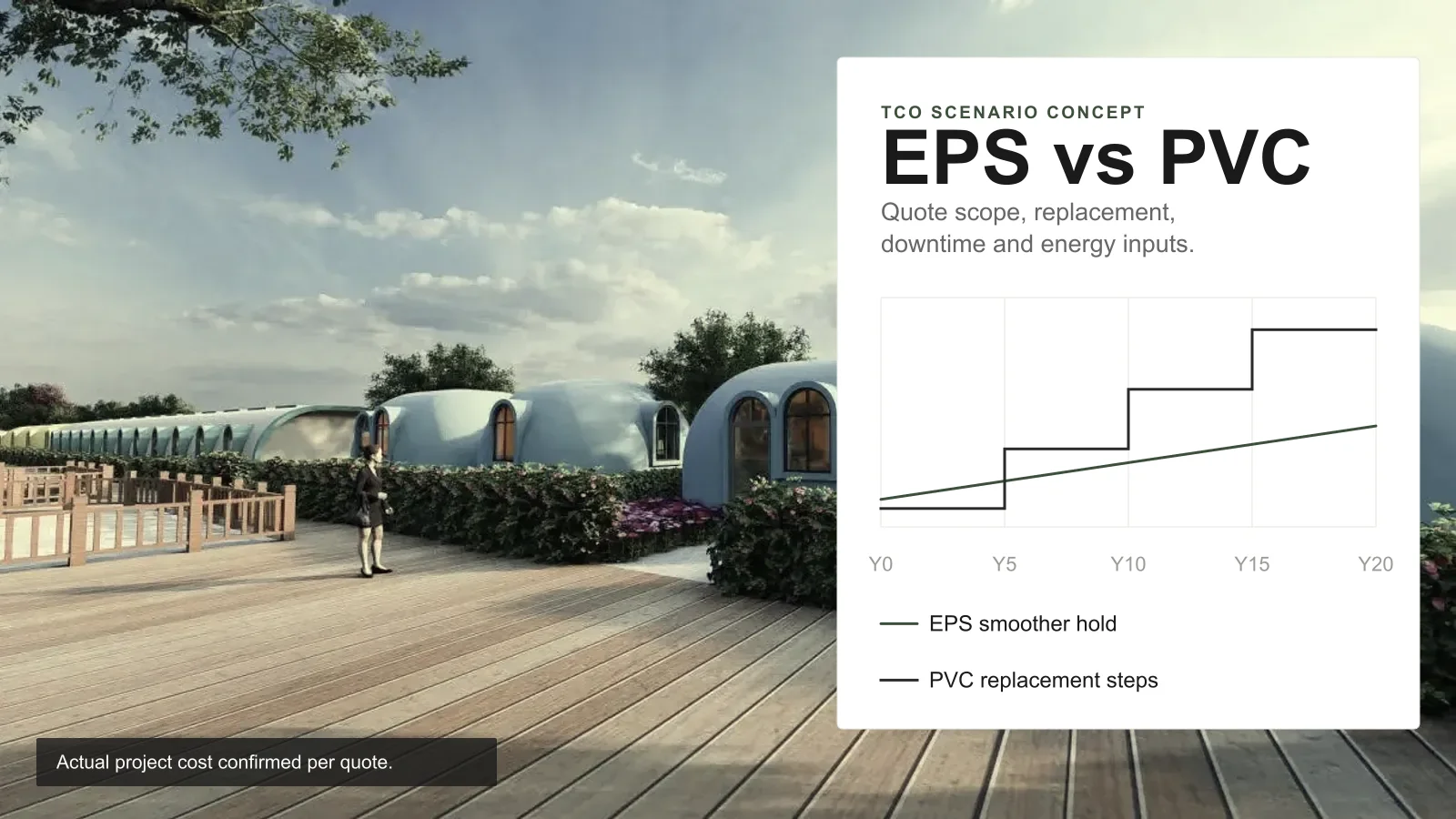
The 30-second decision frame
If this page is forwarded to an owner, finance partner, or project committee, the useful summary is this:
| Decision question | PVC fabric dome tends to win when… | EPS modular dome tends to win when… |
|---|---|---|
| Planning horizon | The site is seasonal, temporary, or campaign-led. | The site is permanent or long-lease, usually 10+ years. |
| Capex pressure | The project needs the lowest day-one unit cost. | The project can trade higher capex for lower lifecycle risk. |
| Envelope replacement | A fabric cover replacement cycle is acceptable in the model. | The buyer wants no recurring fabric-envelope replacement event. |
| Operating season | Shoulder-season or summer operation is enough. | Year-round or near-year-round occupancy is central to revenue. |
| Quote comparison | Vendors are compared at headline price only. | Vendors are compared at shell, freight, site work, and downtime parity. |
| Resort layout | Independent standalone domes are enough. | Linked or clustered dome layouts may matter for family suites or shared spaces. |
The rest of the article explains how to turn that summary into a quote spreadsheet.
What a dome house kit price includes vs excludes
A dome house kit price is useful only when the quote names its boundary. The prices you see while shopping a glamping dome, a dome house kit, or a residential dome often mix DIY geodesic kits, PVC glamping tents, residential dome kits, and supplier-led prefab systems. A resort buyer should normalise every quote into the same scope columns before comparing EPS and PVC.
| Price component | EPS modular dome question | PVC fabric dome question |
|---|---|---|
| Shell / kit package | Are EPS modules, joinery, hardware, mesh, mortar, coatings, doors, and windows included? | Are frame, fabric cover, insulation liner, door, windows, platform interface, and replacement cover assumptions included? |
| Export packaging and freight | Is export reinforcement packaging included, and what Incoterm transfers risk? | Is the frame / membrane packed for international freight, and who carries moisture or damage risk? |
| Foundation and installation | Who supplies anchors, local foundation engineering, assembly crew, tools, lifts, and site supervision? | Who supplies deck, anchors, tensioning labour, fabric installation, and seasonal dismantling or storage labour if needed? |
| Operational fit-out | Are MEP, HVAC, bathroom, interiors, furniture, and local code items excluded or quoted separately? | Are insulation, HVAC, bathroom pod, flooring, furniture, and utility connections included or local add-ons? |
| Lifecycle items | What coating, sealant, gasket, HVAC, and inspection cycle should be budgeted? | What cleaning schedule, fabric-cover warranty, liner replacement, window-film replacement, and closed-night downtime should be budgeted? |
Do not compare a shell-only EPS package with a “turnkey-looking” PVC render, or a PVC tent price with an EPS ready-to-move-in quote. The price label matters less than the included / excluded list behind it.
What is actually being compared
Most procurement confusion starts because “dome” is a shape word, not a structural classification. An EPS modular dome and a PVC fabric glamping dome can share a silhouette while behaving like very different assets.
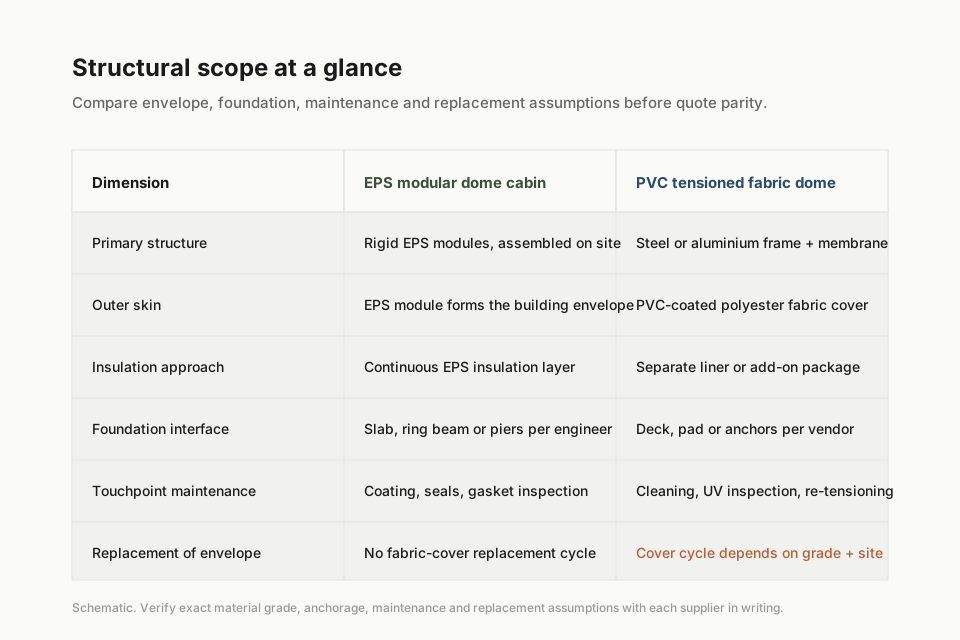
EPS modular dome, Vaultwerk Dome Series. The wall system is built from 18 cm expanded polystyrene (EPS) modules in the current production documents. The panels are assembled on site, then finished with mesh, mortar, coatings, doors, windows, and project-specific interiors. The product behaves more like a small insulated building envelope than a tent because the envelope is built from rigid insulation modules rather than a tensioned fabric cover. The Dome Series product page lists the EPS layouts these figures are based on.
The practical advantage is that there is no PVC fabric roof cover to replace on a recurring operating cycle. The practical trade-off is that the unit is heavier, less relocatable, and more dependent on a deliberate foundation and local code review.
What actually wears out on an EPS dome
“No fabric cover to replace” does not mean “zero maintenance.” It means the parts that wear are different, and on a 10-year resort model they sit on longer cycles than a fabric cover. The manufacturer’s service-life guidance breaks the envelope into layers rather than a single number:
| EPS dome layer | Manufacturer service-life guidance | What it means for the TCO model |
|---|---|---|
| EPS modules (structure) | ~30 years | No recurring structural replacement event in a 10-year hold. |
| Anti-crack mortar + mesh render | 20-30 years | Inspected, not on a replacement cycle within the model horizon. |
| Waterproofing layer | 20-30 years | Budget inspection, not routine replacement. |
| Exterior coating (putty + emulsion / paint finish) | 3-5 years | The one recurring item: a planned recoat for soiling and UV fade. Treat cost and work window as a per-site, per-warranty input. |
| Galvanised steel hardware / frame | 20-30 years (non-saline sites) | Conservative figure; hot-dip galvanised steel typically lasts far longer inland, while coastal salt-spray exposure shortens it. Confirm the spec for your site. |
The honest takeaway for a procurement model: the EPS dome trades a major recurring event — full fabric-cover replacement, when the PVC quote assumes cover replacement within the 10-year hold — for a smaller recurring event — a planned coating recoat every few years, with cost and work window confirmed by site conditions and warranty. That difference belongs in the Maintenance and Replacement rows of the worksheet below, not in a slogan. Ask any supplier for these layers in writing and tie them to the warranty rather than to a single “lasts 30 years” claim.
PVC fabric / geodesic glamping dome. Most commercial glamping domes use a steel or aluminium frame with a PVC-coated polyester or similar fabric cover. The cover is the weather barrier. Insulation, when included, is usually a separate liner or layered interior package, and the exact thermal result depends on fabric grade, liner design, air leakage, and installation quality.
Published glamping dome maintenance guidance commonly treats the cover as an inspected, cleaned, and eventually replaced component. Tendars describes high-grade PVC and coated glamping fabrics as a 5-10 year routine-use category, while other architectural PVC membrane sources can cite longer service lives for heavier-grade permanent membranes. That spread is exactly why the replacement assumption must be written into the supplier quote rather than borrowed from a generic article.
The fair comparison is not “EPS dome vs dome tent” as a label. The fair comparison is: what is included, what wears out, who installs it, what closes the unit, and what the buyer pays over the hold period.
TCO formula for a resort dome
Use one formula for both vendors:
10-year TCO = initial unit + export packaging + freight
            + foundation + installation
            + maintenance + replacement
            + downtime loss + energy delta
Each line item should be a written quote input, not a sales-call memory.
| TCO variable | What to ask both vendors | Why it changes the answer |
|---|---|---|
| Initial unit | What exactly is included in the base unit price? | PVC often starts lower, especially before insulation, platform, and fit-out are added. |
| Export packaging | Is export-grade crating, lashing, and moisture protection included? | Factory materials and container-ready goods are not the same scope. |
| Freight | What is the per-unit landed cost to my nearest container port? | EPS modules load differently from folded membrane/frame systems. |
| Foundation | What foundation is specified for my soil, wind, and snow conditions? | PVC can be simpler on raw level ground; EPS is usually a more permanent site decision. |
| Installation | Crew size, labour-hours, tool list, and buyer-supplied tools? | A fast assembly claim means little without crew size and prerequisites. |
| Maintenance | What annual schedule and budget should I model per unit? | PVC cover cleaning and inspection are different from paint, seal, gasket, and HVAC checks. |
| Replacement | How many envelope replacement events are assumed in 10 years? | This is the largest hidden variable in many fabric-dome comparisons. |
| Downtime loss | How many closed nights per maintenance or replacement event? | A low repair bill can still be expensive if it closes revenue inventory. |
| Energy delta | What is the wall or assembly R-value / U-value and HVAC assumption? | Insulated EPS modules and fabric-plus-liner systems should be modelled by climate zone, not slogan. |
The model should be built for 10 years first, then stress-tested at 15 and 20 years if the land tenure supports a longer asset life.
For cold-climate projects, run the same worksheet with a single-year HDD-based heating-cost formula, an EPS vs PVC envelope U-value comparison, and the local code path for the destination market — see the insulated dome house for cold climates guide — before feeding the result into the 10-year stacking math above.
A better worksheet than a fake price table
Publishing one universal TCO number would be false precision. A coastal UK glamping site, a desert resort, and a cold-climate mountain property will not share the same cover life, HVAC load, foundation cost, or downtime window.
What is useful is a worksheet that forces every supplier into the same columns:
| Line item | Supplier A input | Supplier B input | Evidence required |
|---|---|---|---|
| Base unit price | Vendor quote | Vendor quote | Line-item BoM, not a single headline number |
| Scope tier | Shell / ready / turnkey | Shell / ready / turnkey | Inclusion matrix |
| Export packaging | Included / excluded | Included / excluded | Packaging method and liability point |
| Freight to port | Quote or estimate | Quote or estimate | Incoterm, container plan, port |
| Foundation | Local estimate | Local estimate | Foundation specification |
| Installation | Labour-hours x rate | Labour-hours x rate | Crew size, tool list, prerequisites |
| Annual maintenance | Annual budget | Annual budget | Written schedule |
| Replacement event | Cost x count | Cost x count | Cover / panel / envelope assumption |
| Downtime | Nights closed x ADR x occupancy | Nights closed x ADR x occupancy | Operations calendar |
| Energy delta | Modelled locally | Modelled locally | Climate zone, set points, R/U-value |
For downtime, use your own ADR and occupancy. As a neutral example, the 2025 Glamping Show Americas industry summary reported a US glamping ADR around $251 per night. At 60% occupancy, a 14-night closure represents roughly:
$251 ADR x 60% occupancy x 14 nights = $2,108 lost revenue per unitThat is not a universal claim. It is an editable assumption that shows why replacement timing belongs in the TCO model.
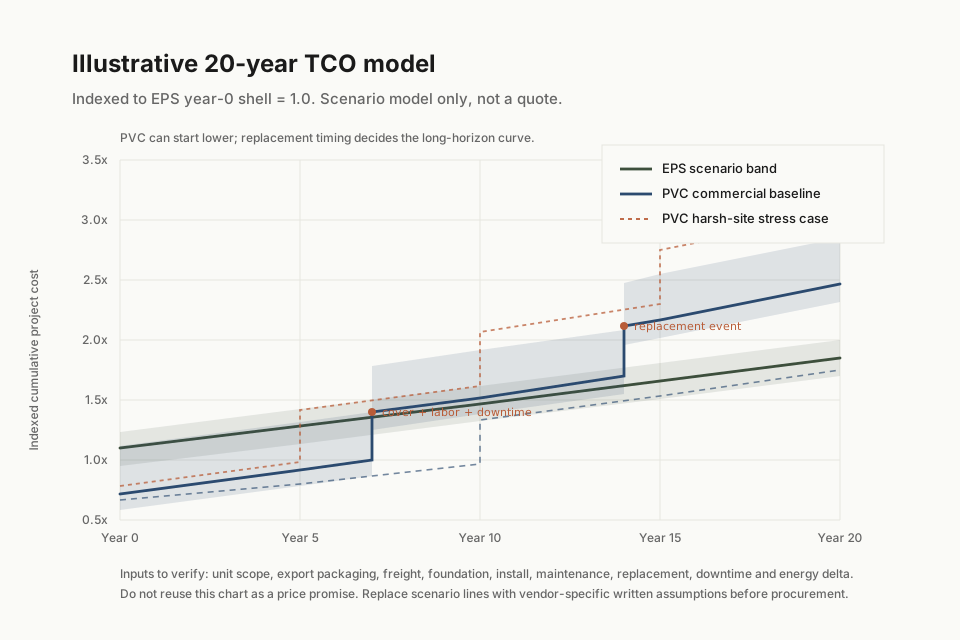
The figure is intentionally indexed, not priced. The Y-axis uses the year-0 EPS shell as 1.0. The PVC scenarios start lower, then step upward when a fabric-cover replacement event is assumed. The timing of those steps should come from the supplier’s stated cover grade, warranty, site exposure, and maintenance schedule.
Quote scope is where most bad comparisons start
A “dome quote” can mean five different things. Before comparing EPS against PVC, force every vendor to mark the same boundary.
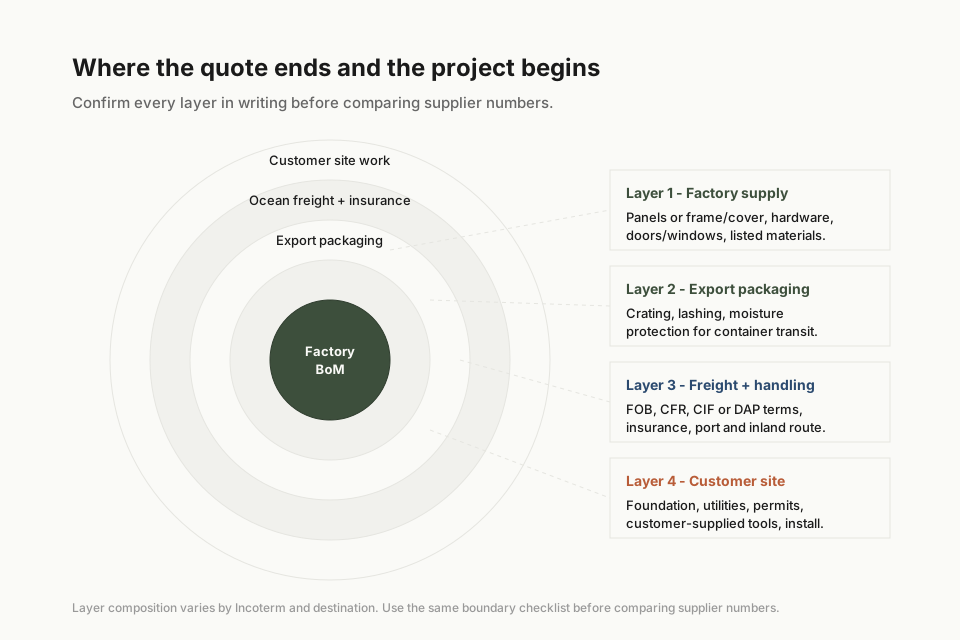
Shell-only. Factory-supplied structural and envelope materials: panels or frame/cover, connectors, doors/windows where included, and basic listed finishing materials. For the Vaultwerk Dome Series, the factory documentation is closer to shell-and-materials than finished hotel room. The buyer still needs to model foundation, utilities, local trades, interiors, fixtures, HVAC, and permits.
Ready-to-move-in. Shell plus interior finishes, electrical rough-in and termination, plumbing rough-in, basic lighting, flooring, wall/ceiling finish, and selected cabinetry. This scope can exist for some product lines, but it must be itemised. A “ready” quote that excludes fixtures, furniture, HVAC, or local utility connection is not turnkey.
Turnkey. Ready-to-move-in plus HVAC, plumbing fixtures, furniture, appliances, exterior deck, local utility connection, and site handover. This usually requires local contractor participation. A Chinese factory can supply many materials, but local code, site works, trade licensing, and occupancy approvals remain local responsibilities.
Incoterm. FOB, CFR, CIF, and DAP are shipping-risk and responsibility terms, not building-scope terms. A FOB quote can be shell-only or ready-to-move-in. Do not let Incoterms hide missing scope.
Customer-supplied items. Permits, foundation, site preparation, septic, electrical service, water tap, local inspections, and certain installation tools often sit outside the factory quote. They are still part of project cost.
The cleanest procurement move is to send every vendor the same scope checklist and require a marked response. If a vendor refuses to state what is excluded, treat that as useful information.
Certification and code language must stay exact
Do not accept broad claims like “CE certified”, “B1 fireproof”, “meets all local codes”, or “approved for the USA” without documents.
For any EPS or PVC supplier, ask for:
- The testing standard, not only the marketing label.
- The classification or result exactly as written.
- The report number, report date, and testing body.
- Whether the report covers the material, a panel, or the full wall/roof assembly.
- Whether local project approval is still required in your jurisdiction.
This matters because CE marking for construction products is tied to declared performance and the applicable European route, not a blanket quality mark. Fire classification labels also need precision: a supplier may use “B1” as shorthand, but buyers should still request the exact report standard and class.
For Vaultwerk inquiries, existing factory documentation can be provided during quote review where available. Jurisdiction-specific items such as ASTM E84, NFPA 285, CSA A277, AS/NZS 3959 BAL, local building permits, and occupancy approvals are not assumed to be standing Vaultwerk certifications. They are project-specific checks.
Linked dome layouts: a resort-specific EPS advantage
PVC fabric domes are typically planned as standalone guest units, sometimes connected visually by decks or fabric walkways. EPS modular domes open a different planning question: can the resort use linked or clustered units for higher-value room types?
Vaultwerk’s current product direction includes physically connectable dome layouts within the Dome Series, such as a smaller dome linked to a larger dome for a family suite or shared lounge concept. That is a resort-developer angle, not just a product-spec detail. It can affect ADR, guest mix, site density, and the ability to create honeymoon suites, family suites, public clusters, or reception / spa combinations.
This should not be oversold before engineering confirmation. For any linked layout, the quote must confirm the connection matrix, node detail, waterproofing, insulation continuity, fire performance, wind-load treatment, and connection pricing. Treat “connectable” as a design option to verify, not as a generic promise.
When PVC actually wins
A credible buyer guide should say when the alternative is better. PVC fabric domes are the right answer in several concrete situations.
Short-term seasonal pop-ups. A wedding venue or event operator running a six-month spring-summer dome cluster on leased land may need a product that can be dismantled, folded, stored, or moved. EPS modular domes are not the right recommendation for that use case.
Low-budget pilots. A first-time glamping operator testing a three-unit site with tight capex may need the fastest route to paid occupancy. PVC’s lower initial unit price and lighter deployment can make sense if the pilot may be replaced or upgraded later.
Brand campaigns or 1-2 year experiments. If the asset will be written off before the cover replacement cycle matters, PVC’s visual flexibility and simpler setup can win.
Sites where local code treats the dome as temporary accommodation. A buyer may prefer a fabric system if local approval pathways are easier for temporary or seasonal structures than for permanent building stock.
EPS becomes stronger when the land is permanent or long-lease, the operating season is long, the operator cares about lifecycle cost rather than capex only, and the project benefits from a more building-like envelope or linked layout options.
Resort-buyer decision checklist
Send these questions to every dome supplier on your shortlist:
- Quote scope: Is this shell-only, ready-to-move-in, or turnkey? Provide the line-item BoM.
- Envelope life: What useful life do you assume for the panel, cover, liner, window film, and seals under my site conditions?
- Replacement events: How many replacement events does your 10-year model assume, and what is the per-event cost?
- Maintenance schedule: What cleaning, inspection, coating, sealing, re-tensioning, or HVAC service is required annually?
- Thermal performance: What R-value or U-value applies to the actual wall/roof assembly, not just one material layer?
- Foundation specification: What foundation do you specify for my soil, snow load, wind exposure, and local code pathway?
- Installation responsibility: What crew size, labour-hours, tools, lifts, scaffolding, and customer-provided items are required?
- Freight and customs: What is the per-unit landed cost, what Incoterm applies, and where does damage liability transfer?
- Certifications: Which test reports exist today, with standard, class, date, testing body, and report number?
- Lead time: What is the production schedule, packaging schedule, port schedule, and estimated arrival window?
- Payment terms: Deposit, milestone payment, balance trigger, and whether escrow or L/C is available for larger orders.
- References: Can you provide dated project photos or customer references from comparable markets?
- Exclusions: What do buyers most often assume is included, but is not?
- Linked layout limits: If you offer connected dome layouts, what connection matrix and node detail can you document?
For Vaultwerk inquiries, the first form field that matters is unit count: 1-5, 5-20, 20-100, or 100+ units. The response path changes with project scale, production scheduling, cash-flow risk, and whether the project needs standard export support or factory engineering review. Request Quote.
Sources & further reading
- Tendars - How Long Can a Glamping Dome Tent Last (https://www.tendars.com/how-long-can-a-glamping-dome-tent-last-tendars.html) - Used for the public PVC / coated-fabric lifespan range and the factors that shorten fabric life: UV, moisture, wind, temperature variation, and usage intensity.
- Northern Glamping - How to Clean Your Glamping Dome’s PVC Cover (https://northernglamping.com/blogs/glamping-guide/how-to-clean-your-glamping-dome-s-pvc-cover) - Used for the recurring PVC-cover cleaning workload and the 3-6 month cleaning interval.
- Glamping Dome Store - Maintenance practices and protective measures to extend the life of your dome tent cover (https://www.glampingdomestore.com/blogs/news/how-to-make-your-geodesic-dome-cover-last-longer) - Used for UV, ventilation, clear-window-film, mildew, and operator maintenance context.
- International Glamping Business - Glamping Show Americas 2025 industry report summary (https://www.glampingbusiness.com/2025/10/02/glamping-show-americas-unveils-third-annual-glamping-industry-report/) - Used for the example $251 ADR assumption in the downtime worksheet.
- Birdair - PVC Tensile Membrane Structures (https://www.birdair.com/membrane/pvc/) - Used to acknowledge that heavier architectural PVC membranes can have longer design lives than typical glamping-dome cover assumptions.
- U.S. Department of Energy - Insulation Materials (https://www.energy.gov/energysaver/insulation-materials) - Used to frame EPS as insulation material and avoid overstating heat-storage claims.
- European Commission - Declaration of Performance and CE marking (https://single-market-economy.ec.europa.eu/sectors/construction/construction-products-regulation-cpr/declaration-performance-and-ce-marking_en) - Used to tighten CE / declared-performance language for construction products.
- Betontechnische Daten - Fire behaviour under DIN 4102 and EN 13501-1 (https://www.betontechnische-daten.de/de/brandschutz/nach-din-13501/brandverhalten-von-baustoffen) - Used to avoid casually mapping B1 to EN 13501-1 without the exact test report.
- Vaultwerk production-side service-life guidance, June 2026 - Source for the layered EPS service-life table (EPS modules, mortar render, waterproofing, exterior coating recoat cycle, galvanised steel hardware). Manufacturer guidance, not a third-party durability test; confirm per project quote and warranty.
Buyer Questions
Is an EPS dome cheaper than a PVC glamping dome?
On the day-one unit price alone, usually no. PVC fabric domes often list below comparable EPS modular domes before insulation, fit-out, foundation, and replacement assumptions are added. On a 10-year resort TCO model, EPS can become more competitive when the buyer includes cover replacement, downtime, maintenance labour, and year-round operating requirements.
How much does a glamping dome or dome house cost?
A glamping dome or dome house cost cannot be compared from one headline number. Ask for the SKU or diameter, unit count, scope tier, shell or kit inclusions, export packaging, Incoterm, freight boundary, foundation assumption, installation responsibility, MEP, interiors, HVAC, local permits, and certification requirements. Vaultwerk does not publish a universal USD price band on this page because the buyer needs quote-scope parity first: shell-only against shell-only, ready-to-move-in against ready-to-move-in, and turnkey-style scope only when every included and excluded item is named.
What should a resort buyer include in dome TCO?
Use nine variables: initial unit, export packaging, freight, foundation, installation, maintenance, replacement, downtime loss, and energy delta. The important rule is quote-scope parity. Compare shell-only to shell-only, ready-to-move-in to ready-to-move-in, and turnkey to turnkey.
How often does a PVC dome cover need replacement?
It depends on material grade, UV exposure, humidity, wind, temperature swing, usage intensity, cleaning, and storage. Public glamping-dome guides commonly discuss a 5-10 year range for high-grade PVC or coated fabrics under routine use, while heavier architectural membrane systems may claim longer service lives. Ask the vendor for the cover grade, warranty, and site-specific replacement assumption in writing.
Do PVC domes require regular cleaning?
Yes. Operator-facing guidance commonly treats cover cleaning as recurring work, not optional cosmetic care. Northern Glamping recommends cleaning PVC covers every 3-6 months, and other dome-cover maintenance guides focus on UV exposure, mildew, window-film degradation, ventilation, and regular inspection. Put that labour into the TCO worksheet.
Can EPS dome cabins be used year-round?
They are better suited to year-round modelling than single-skin fabric shelters because the envelope is built from insulated EPS modules. Do not translate that into a universal energy-savings percentage. The right procurement input is the assembly R-value or U-value, climate zone, air-sealing detail, set-point temperature, and HVAC system. The 18 cm EPS module is a strong starting point, but local modelling still matters.
How long does an EPS modular dome last, and what maintenance does it need?
Treat it as layered, not a single number. The manufacturer's service-life guidance puts the EPS modules at about 30 years, the anti-crack mortar render and waterproofing at 20-30 years, and the galvanised steel hardware at 20-30 years on non-saline sites. The one recurring item is the exterior coating, which is typically recoated every 3-5 years for soiling and UV fade — a planned finish refresh whose cost and work window are confirmed per site and warranty, rather than a full fabric-cover replacement event. Ask the supplier to tie each layer to a written warranty for your site conditions.
Are certifications included in the quote?
Existing factory documents can support quote review, but certifications must be named precisely by standard, result, testing body, and date. Local compliance items are destination-specific. A CE-marked document or SGS report is not the same as a local building permit, ASTM E84 result, NFPA 285 assembly result, CSA A277 approval, or AS/NZS 3959 bushfire pathway.
What quote scope should I request for a 5-20 unit resort project?
Request both shell-only and operational-ready estimates. The shell-only number helps compare suppliers at factory scope. The operational-ready estimate shows the real project budget, including local trades, foundation, utilities, permits, interiors, HVAC, and site work. The difference between those two numbers is where many resort pro-formas fail.